
By Low Handicap Golf | Updated May 2026
Let’s answer the question in the title before we get into the recommendations: yes, blade irons are worth it — for the right golfer. That qualifier matters enormously. A set of Mizuno Pro S-1s in the bag of a 20-handicapper is not an investment. It’s a mistake. Those irons will punish every imperfect strike, provide no help on mishits, and actively make the game harder. The same irons in the hands of a 4-handicapper with consistent ball-striking will return feedback, workability, and feel that no cavity back can replicate.
The premium iron market in 2026 has never been more nuanced. Pure blades sit at one end — muscle-back forgings designed for elite ball-strikers who want the clearest possible feedback on every strike. Players’ distance irons sit at the other — hollow-body forgings that look like blades at address but produce distance and forgiveness numbers that approach game-improvement designs. Between them is a category of players’ cavity backs: compact, forged, slightly more forgiving than a blade without the performance compromises of a players’ distance iron.
This guide covers five of the best premium iron sets available in 2026, spanning pure blades to players’ distance models, with honest assessments of who should be playing each one.
What Makes a Premium Iron Worth the Price?
Before getting into specific models, it’s worth understanding what you’re paying for when you spend $1,300 to $1,700 on a set of irons.
Forging quality and feel. Cast iron heads — poured into molds — produce acceptable performance but a harder, less nuanced impact feel. Forged irons, machined from solid billets of steel through multiple pressing stages, produce the softer, more responsive feel at impact that better players rely on for distance calibration and shot feedback. Mizuno’s Grain Flow Forged HD process in Hiroshima, Japan, is the most celebrated forging operation in golf for a reason — the consistency and feel it produces is measurably different from cast alternatives.
Precision milling. Premium iron faces are milled to exact tolerances after forging — groove geometry, face angle, and surface texture are machined to specifications that produce consistent spin rates and ball speeds that cast faces can’t achieve with the same reliability.
Material selection. The best premium irons use specific steel alloys chosen for their acoustic and feel properties. 1025E mild carbon steel (used by Titleist), 8620 carbon steel (Ping, TaylorMade), and S25C steel (Mizuno) each produce slightly different feel characteristics at impact — all of them superior to the stainless steel used in most mid-range irons.
What you don’t necessarily get: Maximum forgiveness. Premium irons in the blade and players’ cavity category are designed for consistent ball-strikers who want feedback. Golfers who miss the center of the face regularly will not extract premium performance from premium irons.
Our Top 5 High-End Golf Irons in 2026
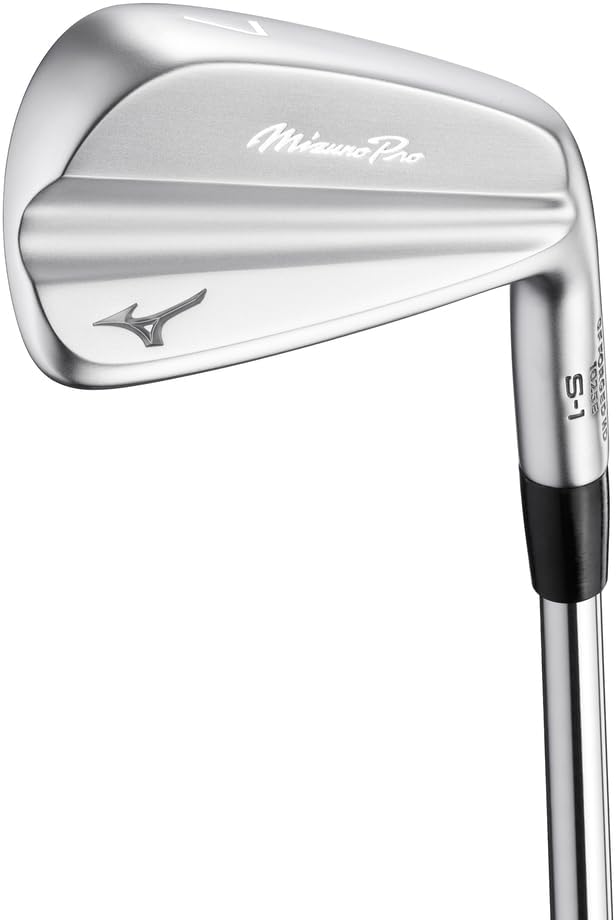
1. Mizuno Pro S-1 — Best Pure Blade in 2026
Price: ~$215/club (~$1,505 for 5-PW, 7-club) | Category: Pure muscle back blade
The Mizuno Pro S-1 is the newest addition to Mizuno’s Signature Series and arguably the purest blade available in 2026. Grain Flow Forged HD in Hiroshima, Japan from a copper-underlay billet, the S-1 uses a Channel Back design that adds subtle forgiveness without compromising the clean, minimal aesthetic that blade purists demand. The H.I.T. (Harmonic Impact Technology) is engineered to perfect sound and feel at impact — not through dampening or inserts, but through precise cavity geometry that produces the acoustic signature Mizuno has built its reputation on.
At address, the S-1 is immaculate. Thin topline, minimal offset, a face height that sits lower than most blades for a more compact, tour-validated look. Multiple reviewers have described the feel as “golfing bliss” when the center of the face is struck — a response unlike anything a hollow-body or cavity-back iron can produce.
The honest caveat: this is a blade in the purest sense. It will not cater to golfers who stray from the center of the clubface. Mishits are penalized clearly — in distance, in direction, and in the feedback through the hands. That’s exactly what the target player wants. If you’re shooting to break 75 and you want your irons to tell you exactly what your swing is doing on every shot, these are the irons that do that better than anything else in the world.
Pros:
- Grain Flow Forged HD in Hiroshima — the most celebrated forging process in golf
- Channel Back design adds subtle forgiveness without compromising pure blade aesthetics
- H.I.T. technology produces the acoustic signature Mizuno is legendary for
- Unmatched feedback on every strike — the blade that tells you the truth
- Clean, minimal aesthetic that rewards good swings with genuine satisfaction
Cons:
- Pure muscle back — demanding of consistent ball-striking, punishes mishits clearly
- $215/club is premium pricing that requires a committed, skilled player to justify
- Not suitable for golfers with handicaps above 5–6 who miss center regularly
- The Channel Back design, while subtle, is a departure from the absolute purity of older Mizuno blades
Best for: Single-digit handicappers and elite ball-strikers who want the purest feedback available in a 2026 iron and are willing to accept the demands of a true blade in return.
2. Srixon ZXi7 — Best Players’ Iron for Feel and Value
Price: ~$200/club (~$1,400 for 5-PW, 7-club) | Category: Forged players’ cavity back
Srixon doesn’t get the headlines of Titleist or TaylorMade in the premium iron conversation, but the ZXi7 is as good an iron as any of them and costs less than most. Golf Monthly called it one of the best players’ cavity-back models available in 2026 — refined from the already-outstanding ZX7 MK II — and the data from independent testing backs that up.
The headline technology is i-FORGED construction — Srixon’s newest forging process that produces a single-piece head with enhanced strength and feel characteristics. The PureFrame ridge, forged directly into the body behind the sweet spot from 80% thicker 1020 carbon steel, reduces unwanted vibration at impact while preserving the soft, solid strike response that serious players demand. The result is what Srixon describes as “remarkably soft yet solid” — a feel that stands up against any iron on this list.
At address, the ZXi7 is exactly what a serious golfer wants: compact shape, narrow topline, minimal offset, tour-preferred aesthetics that look right sitting behind the ball on a tight approach. The workability is excellent — golfers report being able to shape draws and fades with feel rather than mechanical compensation. And for the golfer who wants to blend sets, the ZXi7 pairs seamlessly with the more forgiving ZXi5 for the long irons — the most popular configuration among Srixon’s tour staff, who typically play ZXi5s in the 4 through 6 and ZXi7s from 7 through PW.
Pros:
- i-FORGED technology produces exceptional feel that competes with any iron at any price
- PureFrame ridge delivers soft, solid impact response without masking strike feedback
- Compact, tour-inspired profile — one of the best-looking players’ irons available
- More affordable per club than Mizuno, TaylorMade P7MB, and Titleist T100 alternatives
- Blends seamlessly with ZXi5 for a combo set configuration tour players prefer
Cons:
- Less brand recognition than Titleist or TaylorMade in this category — harder to demo in stores
- Not the most forgiving option here — still demands consistent ball-striking
- Not a pure muscle-back blade — players who want maximum feedback may prefer the Mizuno or P7MB
- Previous ZX7 MK II is available at reduced pricing with minimal performance difference
Best for: Low-to-mid handicappers who want tour-quality forged feel and players’ iron aesthetics at a slightly more accessible price than the big-name alternatives — the best value in the premium iron category.
3. TaylorMade P7MB — Best for Shot-Makers
Price: ~$200/club (~$1,200 for 5-PW, 6-club) | Category: Forged blade
The TaylorMade P7MB has been one of the most consistently praised blades in golf for multiple generations, and the current version represents a refinement of everything that made previous generations work. Five-time forged construction from 2000-ton press technology produces exceptional density and consistency in the blade head. A copper underlay in the face softens the impact response without masking feedback — a specific material science decision that improves feel while preserving the strike information a player’s iron demands.
The P7MB’s defining characteristic is workability. Shot-shaping — deliberate draws and fades, trajectory manipulation, the ability to flight the ball up or down with feel changes rather than mechanical adjustments — is more accessible in the P7MB than any other iron on this list. The thin topline and minimal offset encourage the hand position and face angle at address that allows players to genuinely work the ball.
Tiger Woods trusts his custom TaylorMade P7TW Prototype irons, a direct descendant of the P7MB design philosophy. The DNA is real, and the performance at the elite level validates the design.
Pros:
- Five-time 2000-ton press forging produces exceptional feel and consistency
- Copper underlay face improves feel while preserving precise strike feedback
- Best-in-class workability for deliberate shot-shaping on the course
- Tour-proven design ancestry tracing through decades of TaylorMade players’ iron development
- Slightly more accessible price per club than Mizuno or Ping blade alternatives
Cons:
- Pure blade — demands consistent center contact and punishes heel/toe misses clearly
- No forgiveness assistance from MOI enhancement technology
- The compact, thin profile provides minimal visual confidence for anyone below a 5 handicap
- Limited ability to fade/draw without affecting distance significantly in the long irons
Best for: Low-handicap shot-makers who want the most workable blade in the TaylorMade lineup and value deliberate trajectory and shape control over everything else.
4. Titleist T100 — Best Players’ Cavity Back for the Improving Golfer
Price: ~$200/club (~$1,400 for 4-PW, 7-club) | Category: Compact players’ cavity back
The Titleist T100 is the iron that bridges blade performance and real-world usability for the 3-to-10 handicap golfer who wants premium feel without the full demands of a muscle-back blade. It’s a compact cavity back forged from 1025E mild carbon steel — the same material Titleist uses throughout their T-series premium lineup — delivering the soft, responsive impact sound and feel that serious players expect from a Titleist iron.
The T100’s cavity back design provides meaningful perimeter weighting that protects against the distance and direction loss on slight off-center strikes that punishes pure blades. Multiple independent 2026 testers ranked it among the top performers for dispersion and carry distance consistency across a range of impact locations — a significant endorsement for a player’s iron category where consistency separates the models worth the premium from those that aren’t.
For golfers who hover between 5 and 10 handicap and want to invest in irons that will grow with them into single-digit territory, the T100 is the correct starting point. It rewards good strikes with premium Titleist feel and provides enough protection on slight mishits to stay competitive on the scorecard.
Pros:
- Premium 1025E mild carbon steel delivers Titleist’s signature responsive feel
- Compact cavity back provides meaningful forgiveness over blades for inconsistent strikers
- Top dispersion and carry consistency results in independent 2026 iron testing
- Clean, compact profile works for 5-to-10 handicappers who don’t want game-improvement aesthetics
- Strong Titleist brand fitting infrastructure and custom spec availability
Cons:
- Less workability and shot-shaping flexibility than a pure blade
- More expensive per club than the TaylorMade P7MB
- The cavity back design produces slightly less distinctive feedback on mishits than a blade
- Not suited for the elite 1-3 handicapper who wants maximum shot-shape feel
Best for: Players between 5 and 10 handicap who want premium forged performance and feel with enough cavity-back protection to stay competitive during rounds where contact isn’t always perfect.
5. TaylorMade P790 — Best Players’ Distance Iron
Price: ~$230/club (~$1,599 for 4-PW, 7-club) | Category: Hollow-body players’ distance iron
We’ve covered the P790 in our Best Irons for a 10 Handicap guide, and it earns a spot here too because no discussion of premium irons in 2026 is complete without addressing the players’ distance category it defines. The P790 looks like a blade at address — thin topline, minimal offset, tour-inspired profile — but performs like a game-improvement iron on the forgiveness and distance metrics that determine average scoring performance.
The hollow-body construction filled with SpeedFoam Air delivers ball speeds and carry distances across a wider area of the face than any solid blade can achieve. A 10-handicapper who hits 60% of their shots on the center of the face will gain distance and forgiveness from a P790 compared to a blade — while losing nothing in terms of visual confidence at address. The feel is different from a pure forged blade — a slightly more muted response at impact — but the distance consistency and forgiveness make it the better scoring iron for the majority of single-digit to mid-handicap players.
The honest positioning: if you’re shooting to be a scratch golfer and want tour validation, a blade is the right aspiration. If you’re a 7-to-15 handicapper who wants the best-looking, most complete performing premium iron set available, the P790 is the answer.
Pros:
- Best players’ distance iron in the game — tour looks with game-improvement distance metrics
- Hollow-body SpeedFoam Air construction delivers ball speeds impossible for a solid blade
- Forgiveness on off-center strikes well above the blade category on this list
- Clean, compact profile at address — indistinguishable from a blade in the bag
- Consistently ranked among the best overall irons in independent 2026 testing
Cons:
- Less feedback on mishits than a pure blade — the forgiveness masks some strike information
- Hollow-body construction produces a different feel to forged solid irons
- Strong lofts mean distance recalibration is required when switching from traditional irons
- Not the right choice for elite ball-strikers who want maximum workability and feedback
Best for: Mid-to-low handicappers who want premium aesthetics and tour validation with genuine performance advantages over blades on forgiveness and distance consistency.
Buying Guide: Who Should Play Premium Irons?
The Skill Level Question
The most important buying guide question for premium irons is also the most uncomfortable: are you good enough? The benchmark most fitting professionals apply is straightforward — if you’re consistently breaking 80 and making center contact at least 60% of the time, a players’ iron or blade will serve you well. If you’re breaking 85 occasionally and fighting a significant miss pattern, a game-improvement or players’ distance iron delivers better average scoring performance regardless of the premium iron’s design quality.
A useful self-test: hit 20 iron shots on a range mat and note the divot pattern. Clean, centered divots that point just left of the target (for a right-hander) indicate consistent ball-first contact. Scuffed, varied divots with inconsistent direction indicate a ball-striking pattern that needs game-improvement forgiveness before premium feedback becomes useful.
The Blade vs. Players’ Cavity vs. Players’ Distance Choice
Three distinct categories appear on this list, each suited to different player profiles:
Pure blades (Mizuno Pro S-1, TaylorMade P7MB) suit golfers who make consistent center contact, want maximum feedback and workability, and accept that mishits will be penalized. Generally appropriate for sub-7 handicappers with established, repeating swings.
Players’ cavity backs (Titleist T100) suit golfers between 5 and 12 handicap who want premium feel with a modest forgiveness buffer. The compact cavity back provides protection on slight off-center strikes without the distance gains of a hollow-body design.
Players’ distance irons (TaylorMade P790) suit golfers between 7 and 15 handicap who want premium looks and feel with the distance and forgiveness performance of a modern construction. The right choice for improving golfers who want to grow into single-digit territory.
The Fitting Imperative
Premium iron performance is highly shaft-dependent. A milled blade face producing feedback through the hands communicates shaft behavior in a way a cast, insert face doesn’t — which means the wrong shaft choice in a premium iron produces a worse experience than a correctly shafted mid-range iron. Shaft weight, flex profile, and tip stiffness all affect the trajectory and dispersion characteristics that premium irons are designed to optimize.
Before spending $1,300 to $1,700 on a set of premium irons, spend $100 to $200 on a proper fitting session. The correct shaft makes a premium iron perform as designed. The wrong shaft makes an expensive iron feel harsh and inconsistent.
The Honest Value Question
Premium irons hold their value better than any other category of golf equipment. A set of Mizuno Pro S-1s in excellent condition will resell for 60 to 70 cents on the dollar — better than almost anything else in the bag. A set of Cleveland game-improvement irons bought at the same price will sell for a fraction. For golfers who buy, play seriously, and occasionally upgrade, the secondary market value of premium forged irons meaningfully offsets the initial investment.
Final Verdict
For the elite ball-striker who wants the purest feedback experience in 2026, the Mizuno Pro S-1 is the finest blade available — Grain Flow Forged in Hiroshima with the feel that defines what a premium iron should be. For shot-makers who prioritize workability above everything else, the TaylorMade P7MB delivers the most deliberate ball-flight control available in a current-generation blade.
For the golfer who wants tour-quality forged feel at a slightly more competitive price, the Srixon ZXi7 is the best value in the premium category — excellent feel, compact aesthetics, and the blending flexibility of the ZXi5 combo setup. For the improving golfer between 5 and 10 handicap who wants premium feel with practical protection on slight mishits, the Titleist T100 is the correct choice. And for the golfer who wants tour looks with genuine performance advantages across the face, the TaylorMade P790 remains the benchmark players’ distance iron and one of the best-performing irons in the entire 2026 market.
Blade irons are worth it — in the right hands, with the right shaft, and with the honest self-knowledge to know which category of premium iron your game actually calls for.
Low Handicap Golf may earn a commission through affiliate links on this page at no additional cost to you. All product recommendations are based on independent research and publicly available testing data.
 Low Handicap Golf
Leave a comment