
By Low Handicap Golf | Updated May 2026
Here’s the uncomfortable reality about most practice sessions: they don’t transfer to the course. Golfers hit bucket after bucket on the range, groove what feels like a better swing, step onto the first tee on Saturday, and make the exact same mistakes they’ve been making for years. The problem isn’t effort — it’s feedback. Without knowing in real time whether your path is wrong, your alignment is off, or your tempo is out of sequence, you’re just rehearsing bad habits with extra volume.
That’s where training aids earn their value. Not the gimmicks — and there are plenty of those — but the genuine tools that provide instant, undeniable feedback that your brain can process, correct, and eventually automate. When Scottie Scheffler still uses a grip trainer on the tour range, and Justin Rose carries a Tour Striker Smart Ball in his bag between tournaments, it’s not because these players are fixing fundamental problems. It’s because external feedback maintains precision that feel alone can’t always guarantee.
The right training aid accelerates learning by closing the loop between what you think you’re doing and what you’re actually doing. These are the six best golf training aids for lowering your handicap in 2026 — covering putting, swing mechanics, chipping, alignment, speed, and tempo — chosen for proven effectiveness, not marketing noise.
Our Top 6 Golf Training Aids to Lower Your Handicap
1. Lag Shot 7-Iron — Best Overall Swing Trainer
Price: ~$120 | Category: Swing/Tempo
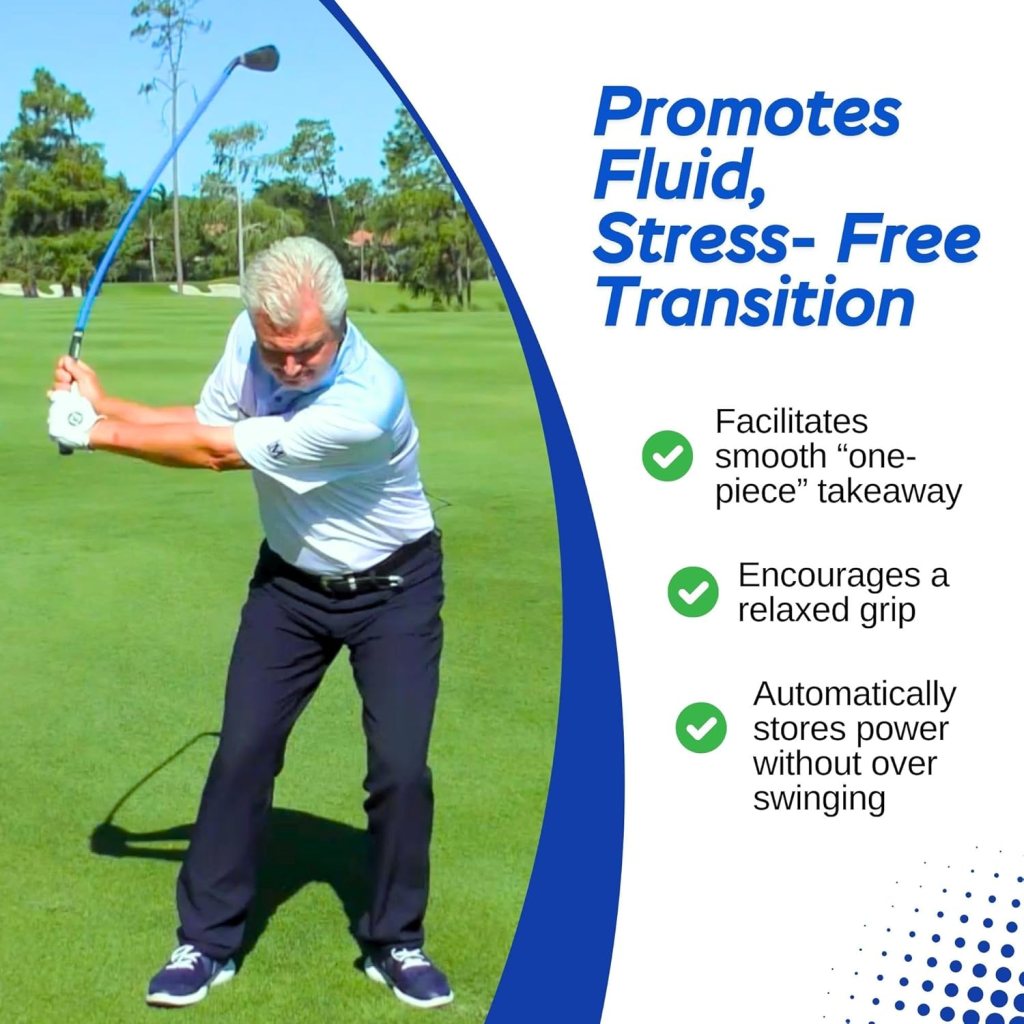
Named Golf Digest’s Editors’ Choice “Best Swing Trainer” and consistently rated the best overall swing training aid across multiple independent reviews, the Lag Shot 7-Iron is the training club that belongs in every serious golfer’s bag. The concept is elegant: it’s a real, hittable 7-iron with an extremely flexible shaft. Because the shaft whips dramatically on any swing that’s out of sequence — casting, rushing the transition, coming over the top — it provides an immediate, unambiguous signal when you’ve made an error. You can’t fake it or muscle through it. You have to earn the proper feel.
The Lag Shot forces three specific improvements simultaneously: it promotes the pause at the top that allows the lower body to initiate the downswing, it demands proper lag retention by requiring active hand/wrist release through impact, and it builds the rhythm and tempo that separate consistent ball-strikers from inconsistent ones. Because you can actually hit balls with it, the feedback loop is complete — you see the flight and feel the impact, not just an abstract sensation. It can also be swung indoors without a ball as a warm-up tool, which means it earns regular use rather than sitting in the garage.
Pros:
- Best overall swing trainer across multiple independent 2026 reviews
- Hittable — complete feedback loop with real ball flight
- Improves lag, tempo, transition, and sequence simultaneously
- Works indoors as a warm-up tool and on the range with real shots
- 30-day money-back guarantee from Lag Shot directly
Cons:
- Steeper price than simpler swing aids at ~$120
- Requires patience — rewards come after adjustment period, not immediately
- The very flexible shaft can feel foreign at first and frustrate impatient golfers
- Heavier than a standard 7-iron — not ideal for golfers with arm or wrist issues
- May not suit absolute beginners who haven’t developed a basic swing foundation
Best for: Mid-to-low handicappers who want a single swing training tool that addresses tempo, lag, and sequence — and are committed to enough practice to feel the transfer.
2. Eyeline Golf Putting Mirror — Best Putting Aid
Price: ~$30–$40 | Category: Putting
Three-putts are the fastest route to a bogey on holes you should be making par, and most golfers have no idea that their alignment and eye position at address are the root cause. The Eyeline Golf Putting Mirror solves this by giving you an exact visual check on every element of your setup — are your eyes directly over the ball? Is the putter face square to your intended line? Are your shoulders parallel to the target line? — in one portable, compact tool that works at home or on the practice green.
The gate slots are the standout feature: two removable pegs that create a narrow gate the putter must pass through cleanly, punishing any face rotation or path deviation at impact. Start with the gate wide and narrow it as your stroke becomes more consistent. Independent testers consistently describe the moment they see their setup issues in the mirror for the first time as a revelation — problems they never knew they had, immediately visible and correctable. At $30–40, the Eyeline Putting Mirror is the highest-return investment per dollar on this entire list.
Pros:
- Instantly reveals eye position, face alignment, and shoulder setup issues
- Gate slots provide real-time feedback on putter path and face angle
- Compact and portable — works at home, office, or on the practice green
- Exceptional value — among the best per-dollar improvements available
- Suits golfers at every level from beginners to low handicappers
Cons:
- Requires honest self-reflection — some golfers resist what the mirror reveals
- The mirror surface can scratch with rough handling — needs careful storage
- Primarily a setup and stroke aid — doesn’t address lag putting or green reading
- Won’t help with distance control on longer putts without supplementary work
Best for: Any golfer who three-putts more than once per round and wants to understand exactly why — the most affordable game-changer on this list.
3. SuperSpeed Golf Training System — Best for Adding Distance
Price: ~$179 (Men’s Set) | Category: Swing Speed
Distance is a skill you can train. SuperSpeed Golf’s overspeed training system is the most validated speed-building tool in golf — used by over 1,000 tour professionals and more than 300,000 golfers worldwide, with studies showing an average speed gain of 10.5% among app users completing 25 or more training sessions. The system consists of three weighted speed sticks — light, medium, and heavy — used in a specific protocol to progressively train your body to move faster. The principle is overspeed training: swinging a lighter-than-normal club trains your neuromuscular system to move at a higher velocity, and that speed translates when you return to your standard driver.
Phil Mickelson is the highest-profile advocate, but the results are consistent across handicap levels. The guided app protocols take 10–15 minutes, three days a week — a realistic commitment that most golfers can sustain through a season. If distance is costing you strokes by forcing longer approach shots into greens, this is the training investment with the most direct ROI in terms of scoring.
Pros:
- Scientifically validated — average 10.5% speed gain across documented training sessions
- Used by 1,000+ tour professionals worldwide
- App-guided protocols are easy to follow and require only 10–15 minutes, 3x per week
- Speed gains persist when you return to your regular driver
- Studies show speed gains reduce dispersion, not increase it
Cons:
- Investment at ~$179 — the most expensive aid on this list
- Requires consistent multi-week commitment to see meaningful results
- Not the right priority if poor contact or course management is losing you more strokes
- Requires adequate physical fitness to execute protocols safely
- Speed without technique improvements can amplify existing swing faults
Best for: Golfers who want to add genuine clubhead speed through validated, tour-proven overspeed training — particularly those who have plateaued at their current swing speed.
4. Eyeline Golf Speed Trap 2.0 — Best Swing Path Aid
Price: ~$119 | Category: Swing Path/Ball Striking
If the slice in your driver or the pull in your irons isn’t responding to swing thoughts on the range, the Speed Trap 2.0 is the feedback tool that cuts through. Four adjustable speed rods are set into a polycarbonate base and positioned around the correct swing path. Miss the path in either direction and you hit a rod — instant, undeniable, physical feedback that no swing thought can replicate. Hit the correct path and the rods remain untouched.
What makes the Speed Trap more than a path trainer is its adaptability. It has marked ball positions for chipping, pitching, and full swings, making it one of the most versatile aids on the range. Golf Monthly called it “without doubt one of the best training aids on the market” after testing, with testers specifically noting the clarity of path feedback and the carry-over to course performance. For golfers who have been trying to cure a slice or over-the-top move through swing thoughts alone, the Speed Trap provides the physical constraint that thought can’t.
Pros:
- Immediate, physical feedback on swing path — no guesswork
- Versatile — works for chipping, pitching, and full swings from the same base
- Helps groove both draw and fade paths, not just one swing shape
- Named one of the best training aids by Golf Monthly’s 2026 test team
- Develops genuine muscle memory for path changes that transfer to the course
Cons:
- Higher price point at $119 — not an impulse purchase
- Takes time to set up correctly on the range — not instant to deploy
- Can be frustrating for golfers who hit rods repeatedly before feeling improvement
- Polycarbonate base can slide on certain range mat surfaces
- Focuses on path — doesn’t address clubface angle independently
Best for: Mid-to-high handicappers with persistent path problems (slice, over-the-top, pull) who want immediate, physical feedback to replace ineffective swing thoughts.
5. Tour Striker Smart Ball — Best Connection and Release Trainer
Price: ~$40 | Category: Swing/Connection
Already featured in our slice-fixing guide, the Tour Striker Smart Ball earns a second mention here because it addresses one of the most common swing faults across all handicap levels: disconnection between the arms and body. The small inflatable ball clips to an adjustable lanyard, rests between your forearms at address, and must be kept there throughout the swing. Drop it — through a flying elbow, a chicken wing through impact, or a disconnected takeaway — and you know immediately what went wrong and where.
The result of keeping the ball in place is synchronized arm-body rotation, which produces a more consistent path, a natural release through impact, and the kind of connected, rotating swing that generates power efficiently rather than through arms alone. Tour-level players use it to maintain connection under pressure. Mid-handicappers use it to build the connection they’re still developing. At $40 for a tool used on the tour range by players including Justin Rose, the value proposition is genuinely exceptional.
Pros:
- Immediate physical feedback on arm-body disconnection
- Used by Justin Rose and other tour professionals as a genuine training tool
- Works for full swing, pitching, chipping, and putting
- Adjustable and inflatable — works for any golfer’s build
- Exceptional value at ~$40 for genuine tour-level training feedback
Cons:
- Requires established basics (grip, posture) to use effectively
- Some users report occasional air leaks in the inflatable ball
- Full swing shots with it can feel awkward initially — start with half swings
- The connection it teaches can feel unnatural to golfers with ingrained disconnection
- Doesn’t address alignment or setup independently
Best for: Golfers at any level who want to build arm-body synchronization and eliminate the chicken wing, flying elbow, or disconnected release through the hitting zone.
6. Alignment Sticks — Best All-Purpose Training Tool
Price: ~$10–$25 (pair) | Category: Alignment/All Areas
Every serious golfer should have a pair of alignment sticks in their bag, and if you don’t, this is the first purchase to make before any other training aid on this list. Alignment sticks are the most versatile, most portable, and best-value training tool in the game. They cost next to nothing, fit in any golf bag, and can be configured to address almost every fundamental — aim, ball position, swing path, hip and shoulder alignment, T-drill ball striking, gate drills for putting, and more. The fact that tour professionals use them constantly should tell you everything about their effectiveness.
For dedicated walkers, the most useful configurations are: two sticks parallel to the target line (one at the toes, one at the ball) to check alignment every session; one stick in the ground to check swing path direction; and two sticks as gate markers for the chip shot landing zone. No other $15 purchase in golf delivers this return.
Pros:
- The best value-per-pound improvement available in golf — under $25 for a pair
- Infinite versatility: alignment, ball position, path, stance, chipping gates, and more
- Used by every tour professional during range sessions
- Fits in any golf bag without adding meaningful weight
- Immediately reveals setup and alignment errors that cost strokes every round
Cons:
- No inherent feedback mechanism — requires knowing which drill to set up
- Can be a crutch if not eventually removed to practice without them
- The quality gap between cheap and premium versions matters — buy fiberglass over plastic
- Limited value for golfers who don’t know which drills to run with them
- They only help if you actually use them — easy to ignore in the bag
Best for: Every golfer at every level — the non-negotiable foundation of any practice toolkit and the first training aid anyone should own.
Buying Guide: How to Choose the Right Training Aid
Diagnose Before You Buy
The most common training aid mistake is buying the wrong tool for your specific problem. A path trainer won’t fix a putting issue. A speed trainer won’t fix a slice caused by an open face. Before purchasing any aid, spend a round tracking where your strokes are actually coming from — three-putts, driver misses, short game failures, or course management errors. Buy the aid that addresses the category where you’re losing the most shots.
Prioritize Feedback Quality
The best training aids share one characteristic: they provide undeniable, immediate feedback you can’t rationalize away. The Lag Shot falls apart if your sequence is wrong. The Speed Trap rings a rod if your path deviates. The putting mirror shows your eyes off the ball the moment you look down. This kind of feedback changes behavior faster than any amount of conscious effort. Avoid aids that provide vague or delayed feedback — the learning loop only closes when the consequence is immediate.
Beware Dependency
Some training aids create a feel that disappears the moment you remove the device. The goal of any training tool is to build a pattern your nervous system can access without the crutch. Use aids intensively for a period, then remove them and check whether the improvement holds. If it doesn’t, more work is needed before the change has been automated. The alignment sticks and Speed Trap are excellent for this reason — you actively remove them and test your unassisted performance.
Match the Aid to Your Practice Environment
Some aids work best on a range with a mat and a bucket of balls. Others — the putting mirror, alignment sticks, the Smart Ball — work equally well in a living room. Before buying, consider where you actually practice. An aid that requires a full range session is far less useful to a golfer who only makes it out once a week than one they can use for 10 minutes in the garage every evening.
Start Simple, Not Expensive
The alignment sticks at $15 and the Eyeline Putting Mirror at $35 will lower more handicaps per dollar spent than any $300 launch monitor or complicated swing analyzer. Build the foundation first. Add technology and complexity when the fundamentals are dialed in and you’re chasing marginal gains.
Final Verdict
For the biggest single improvement per session, the Lag Shot 7-Iron is the most complete swing training tool available — it addresses tempo, lag, path, and sequence with real ball flight feedback. For putting, the Eyeline Putting Mirror is the highest-return purchase at any price. For golfers who want to add genuine distance, the SuperSpeed Golf System has the data behind it that no other speed trainer can match.
For a slice or path problem that isn’t responding to swing thoughts, the Eyeline Speed Trap 2.0 provides the physical feedback that changes behavior. For arm-body connection at tour-level quality for $40, the Tour Striker Smart Ball is the most undervalued tool on this list. And for every golfer, regardless of level, the alignment sticks belong in your bag starting today.
The theme running through every recommendation is the same: the right training aid doesn’t tell you what to do. It tells you what you’re actually doing. That distinction is where every meaningful improvement begins.
Low Handicap Golf may earn a commission through affiliate links on this page at no additional cost to you. All product recommendations are based on independent research and real-world testing.
 Low Handicap Golf
Leave a comment