
By Low Handicap Golf | Updated May 2026
The putter gets used on more shots than any other club in the bag. A driver gets hit 14 times per round. A putter gets hit 30 to 36 times — and for a beginner or high handicapper, it’s often closer to 40. Despite that math, most beginners spend their entire equipment budget on a driver and irons, then grab whatever putter was in the used bin at the pro shop. It’s one of the most reliable ways to leave strokes on the course.
Getting the right putter doesn’t require spending $500 on a Scotty Cameron. It requires understanding what makes a putter beginner-friendly — specifically forgiveness, alignment, and consistent distance control — and choosing a model that delivers those things in a format that builds confidence rather than anxiety at address.
The 2026 putter market is excellent for golfers at this level. Manufacturers have poured genuine technology into game-improvement putter designs, and the performance gap between a $150 beginner-friendly putter and a $500 premium model is smaller than it’s ever been for the things that matter most. Here are the five best putters for beginners and high handicappers in 2026.
Our Top 5 Putters for Beginners and High Handicappers
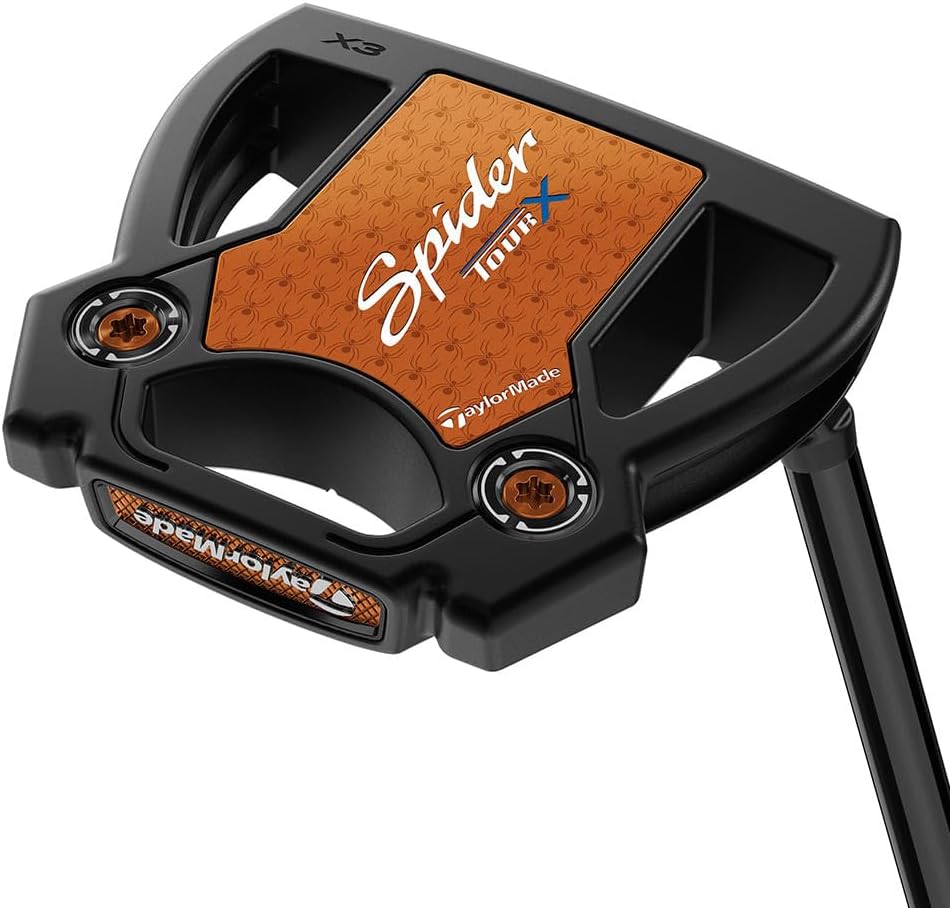
1. TaylorMade Spider ZT — Best Overall for Beginners
Price: ~$299–$350 | Style: Mallet | Best for: SBST strokes
The TaylorMade Spider has been the winningest putter on the PGA Tour for two consecutive years — more wins than any other model since 2024 — and the ZT (Zero Torque) variant takes that proven Spider platform and adds technology specifically engineered to solve the two biggest problems high-handicap golfers have on the greens: face rotation and off-center contact.
The Zero Torque design positions the CG at the center of the shaft, combined with built-in shaft lean and onset, so the putter head stays square to the stroke path throughout the swing rather than opening and closing naturally like conventional putters. For a beginner who hasn’t developed consistent face control, this is a genuine mechanical advantage — the balanced design keeps the head square to the putter’s path throughout the stroke, making it dramatically easier to return the face to square at impact. The True Path alignment system uses thinly milled lines exactly the width of a golf ball, making it easy to center the putter behind the ball at address. The Pure Roll insert promotes forward topspin for a truer, more consistent roll.
Pros:
- Zero Torque design mechanically reduces face rotation — genuine help for inconsistent strikers
- True Path alignment system makes centering the face intuitive
- Pure Roll insert promotes immediate forward roll and consistent distance
- Tour-proven Spider platform gives high-handicappers the same forgiveness top pros use
- High MOI from multi-material construction protects against mishit twisting
Cons:
- $299–$350 is the premium end of this guide — more expensive than value alternatives
- The zero-torque design is specifically suited to straight-back-straight-through strokes — golfers with strong arc strokes may not benefit as much
- Larger head size can feel unusual for golfers transitioning from blade-style putters
- Multiple Spider variants can make choosing the right model confusing
Best for: Beginners and high handicappers with a straight-back-straight-through putting stroke who want tour-proven forgiveness and genuine zero-torque face stability.
2. Odyssey Ai-ONE 2-Ball — Best for Alignment Help
Price: ~$249–$299 | Style: Mallet | Best for: Alignment strugglers
If the biggest problem in your putting game is aiming — and for most beginners, it absolutely is — the Odyssey Ai-ONE 2-Ball is the most immediately useful putter on this list. The 2-Ball alignment system has been around for two decades and remains one of the most effective visual aids in putting: two circles on the crown mimic the appearance of two golf balls side by side, creating a powerful visual reference that trains your eyes to aim the face correctly and consistently.
The 2026 Ai-ONE version upgrades the classic platform with an AI-designed face insert that normalizes ball speed across the hitting area, trained on thousands of real-world mishit patterns. The result is that off-center hits produce more consistent distance than a conventional insert would allow. Combined with the alignment advantage, this putter addresses the two biggest problems beginners face simultaneously: aiming and inconsistent contact. The White Hot insert provides excellent feel — soft and confidence-inspiring off the face.
One honest note: the feel of the insert is a genuine preference issue. Some golfers love the soft, muted response. Others find it too “clicky” compared to a milled face. Try it at the putting green before purchasing if feel is a priority.
Pros:
- Two-Ball alignment system is one of the most effective visual aids in putter history
- AI-designed insert normalizes ball speed on off-center hits — forgiveness where it counts
- Soft White Hot feel is confidence-inspiring at impact
- Mallet design provides high MOI for stability on mishits
- Trusted Odyssey brand with 20+ years of proven alignment technology
Cons:
- Face insert feel divides opinion — some golfers find it “clicky” rather than soft
- The two-circle alignment aid isn’t for everyone aesthetically — test before buying
- Forgiveness is primarily horizontal — vertical mishits (low-face contacts) less addressed
- Some golfers find the large mallet head intimidating rather than confidence-inspiring at address
Best for: Beginners who aim inconsistently and want the most proven alignment aid in the putter market combined with genuine AI-enhanced forgiveness.
3. Cleveland HB Soft 2 — Best Value Putter
Price: ~$149–$175 | Style: Multiple (blade and mallet variants) | Best for: Value seekers
Cleveland continues to release flatsticks under $200 that outperform their price tag — and the HB Soft 2 is their best work yet. At $149.99, it is the best value putter recommendation in 2026, named best budget option by multiple independent reviewers and best budget mallet by Golf Club Brokers, who noted it “punches so far above its weight class it’s almost unfair.”
The CNC milled 304 stainless steel face provides better feedback than you’d expect at this price — a genuine milled feel that most sub-$200 putters can’t deliver. Speed Optimized Face Technology (SOFT) uses variable groove density across the face to normalize ball speed on mishits, meaning the distance control you lose on off-center hits is partially recovered by the face geometry. The heavy head weight (around 365g) is a deliberate design choice that increases MOI and stability — but worth noting that it requires a practice session on the green to recalibrate distance control before taking it to the first tee.
The HB Soft 2 comes in multiple head shapes — blade (#1), mid-mallet, and mallet options — which means golfers at all preference levels can find a shape that suits them within the same value-priced family.
Pros:
- Best value putter in the 2026 market — CNC milled quality at an accessible price
- SOFT variable groove technology normalizes ball speed across the face
- Multiple head shapes in the same price family — blade, mid-mallet, and mallet options
- Milled 304 stainless steel provides premium feedback disproportionate to the price
- Named best budget putter by multiple independent 2026 reviewers
Cons:
- Heavy head weight (~365g) requires dedicated practice to recalibrate distance control
- Alignment aids less sophisticated than premium competitors like the Ai-ONE or Spider ZT
- Not zero-torque — conventional face rotation for golfers who need mechanical stroke help
- The budget positioning means less retail visibility and in-store fitting support
Best for: Budget-conscious beginners and high handicappers who want quality CNC milled performance without spending more than $175 — the best dollar-for-dollar putter available.
4. Ping Scottsdale Prime Tyne 4 — Best for Feel and Stability Together
Price: ~$270–$299 | Style: Mid-mallet | Best for: Golfers who want feel with forgiveness
The Ping Scottsdale Prime Tyne 4 is the beginner-friendly putter for golfers who want both stability and feedback — something that many high-MOI mallets sacrifice in the pursuit of maximum forgiveness. The twin-fork design (the “Tyne” in the name) creates an unusually solid feedback through impact that’s hard to describe until you experience it, while the high-contrast color blocking naturally encourages face squaring at address without demanding the same conscious effort that traditional alignment aids require.
The Ping Scottsdale Prime Tyne 4 is everything we want in a beginner-friendly mallet: stable, forgiving, and confidence-inspiring. The thinner insert delivers a surprisingly soft feel for such a high-MOI design, and it seems to grab the ball and start it rolling without skidding. Ping’s consistent quality control means the Tyne 4 performs exactly as specified from one unit to the next — a practical advantage for a golfer who buys online without testing first. At $270–$299, it sits in the mid-range tier and delivers value that competes with higher-priced alternatives.
Pros:
- Twin-fork design delivers solid, distinctive feedback that builds confidence through impact
- High-contrast color blocking naturally encourages face squaring without obvious visual aids
- High MOI mid-mallet profile provides significant forgiveness on off-center hits
- Thin insert produces excellent feel for a forgiving mallet design
- Consistent Ping quality control — performs reliably straight from the box
Cons:
- Mid-mallet profile sits between blade and full mallet — some golfers find the shape less decisive than either extreme
- Less prominent alignment aids than the Ai-ONE or Spider ZT
- Not zero-torque — conventional opening/closing face behavior through the stroke
- Less widely marketed than TaylorMade and Odyssey equivalents — harder to find to test
Best for: Golfers who want the stability of a mallet with the feedback of a blade — the putter that finds a genuine middle ground between forgiveness and feel.
5. Odyssey Ai-ONE Jailbird Cruiser (Zero Torque) — Best for Maximum Alignment Confidence
Price: ~$299–$349 | Style: Large mallet (zero torque) | Best for: Golfers who miss right consistently
The Odyssey Jailbird Cruiser is Odyssey’s entry into the zero-torque putter category — the growing family of putters designed to stay square to the stroke path rather than opening and closing through impact. Among 2026 reviewers, it’s described as one of the most stable putters tested: the larger head footprint helps with squaring to the target at address, the Versa technology and three alignment dots on the crown create a powerful visual targeting system, and the White Hot urethane insert produces the soft, consistent roll that Odyssey is known for.
For beginners who consistently miss putts to the right — which is typically the result of face rotation through impact — the zero-torque design specifically addresses that pattern by keeping the face from opening during the stroke. The reverse face-balanced design is a genuine mechanical change from conventional putters, and its effectiveness at eliminating the push miss has been validated across multiple independent 2026 reviews. The Cruiser is the putter that transforms golfers who feel helpless over short right-missing putts into golfers who can commit with genuine confidence.
Pros:
- Zero-torque design mechanically prevents face-open impact position — directly eliminates push misses
- Three-dot alignment system and Versa visual technology simplify face squaring at address
- Large head footprint increases MOI for stability on all strike locations
- White Hot urethane insert provides the soft, consistent roll Odyssey’s known for
- Named top pick for beginners and high handicappers by multiple 2026 independent guides
Cons:
- Large footprint isn’t for everyone — some golfers find it visually overwhelming at address
- Zero-torque design works best for golfers with straight-back-straight-through strokes — can feel awkward for strong arc strokes
- On the more expensive end of this guide
- The Jailbird head shape has a distinctive look that some traditionalists find unusual
Best for: Beginners and high handicappers who consistently push putts to the right and want a mechanically engineered solution that addresses the root cause of that miss pattern.
Buying Guide: What Beginners and High Handicappers Need in a Putter
Blade vs. Mallet: Which Style Is Right for You?
This is the central choice in putter selection, and for beginners and high handicappers, the answer is almost always the same: a mallet.
Blade putters (traditional heel-toe weighted designs like the Ping Anser) have a smaller head, lower MOI, and more pronounced face rotation through the stroke. They reward a natural, arcing stroke with excellent feel and feedback. The trade-off: off-center strikes produce more direction and distance inconsistency than a mallet. For golfers who haven’t developed a consistent putting stroke, this penalty amplifies every small inconsistency.
Mallet putters (the Spider, Ai-ONE, Tyne 4, Jailbird) have larger heads, higher MOI, and more perimeter weighting. Off-center strikes retain direction and distance better than blades. The larger footprint typically includes more prominent alignment aids. Mallet putters dominated Today’s Golfer’s 2026 comprehensive putter test, occupying all three podium positions out of 110 models tested — a clear statement about where performance advantage lives for most golfers.
For high handicappers specifically: mallet is almost always the correct choice. The forgiveness advantage is real and measurable, the alignment aids reduce aiming errors, and the confidence from consistent results compounds quickly. As your stroke develops and your handicap drops, you can revisit whether a blade’s feedback advantage becomes worthwhile.
Putter Length: The Spec Most Golfers Get Wrong
Standard putter length is 35 inches for men, 33–34 for shorter golfers. The correct length depends on your height and arm length, and getting it wrong creates posture problems that affect stroke consistency. The test: at address, your eyes should be directly over the ball or just slightly inside the target line, and your forearms should hang naturally from the shoulders without reaching or cramping.
Most mid-size and tall golfers do fine with 34–35 inch putters. Shorter golfers (under 5’7″) often benefit from 33–34 inches. If your back bends uncomfortably at address or your elbows are bent awkwardly, the length is wrong.
A 15-minute putter fitting at any golf shop costs nothing and can solve a posture problem that’s been costing you puts for years. It’s the easiest improvement available to any golfer who hasn’t had one.
Face Insert vs. Milled Face: What Affects Feel
Putters either have an insert in the face (polymer, urethane, aluminum) or a bare milled metal face. Inserts generally produce a softer feel and more consistent roll; milled faces provide crisper feedback and a slightly firmer response at impact. Neither is objectively better — it’s entirely personal preference. The Odyssey White Hot insert is the gold standard in soft inserts. Cleveland’s milled face is the best in the value category for crisp feedback.
If you’ve never putted with an insert-face putter, try the Ai-ONE or Cleveland at a putting green before buying. The feel difference from a cheap cast face is immediately noticeable and helps narrow down the preference quickly.
Final Verdict
For most beginners and high handicappers, the TaylorMade Spider ZT is the most complete package — zero torque, tour-proven forgiveness, and an alignment system that makes aiming intuitive. For pure alignment help, the Odyssey Ai-ONE 2-Ball delivers the most proven visual aid in the game with an AI-enhanced forgiving insert. For golfers who push consistently right, the Jailbird Cruiser’s zero-torque design is the mechanical solution.
On a budget, the Cleveland HB Soft 2 at $150 is genuinely one of the best putter values in the game — CNC milled quality and speed-optimized face technology at a price that makes the decision easy. And for the golfer who wants feedback alongside forgiveness, the Ping Scottsdale Tyne 4 delivers both in a mid-mallet design that grows with your game.
Putting is where scores are actually made. Getting this decision right costs less than a round of golf at most courses — and pays back in fewer three-putts every time you walk onto the green.
Low Handicap Golf may earn a commission through affiliate links on this page at no additional cost to you. All product recommendations are based on independent research and real-world testing.
 Low Handicap Golf
Leave a comment