
By Low Handicap Golf | Updated May 2026
There are two moments most serious golfers experience with a home simulator. The first is standing in the garage after their system’s first session, thinking: I should have done this years ago. The second is the slightly less pleasant moment at the checkout screen, wondering how a practice setup ended up costing as much as a used car.
The good news is that the 2026 home simulator market has never been better for the buyer. Launch monitor technology that cost $5,000 five years ago now ships for under $500. The gap between entry-level and tour-grade accuracy has narrowed dramatically. And with software platforms like GSPro and E6 Connect offering 40,000+ courses at subscription costs that rival a few cart fees, the full simulator experience is genuinely accessible at multiple price points.
The challenge is the overwhelming number of options — and the fact that a wrong choice at the $1,500 level usually means either living with a frustrating setup or spending again to fix it. This guide covers five home simulator recommendations across a wide price spectrum, from the entry-level setup that gets you hitting into a net with real data to the mid-range system that makes your garage the best practice facility within 20 miles. Followed by a buying guide that explains what actually matters before you spend a dollar.
5 Best Home Golf Simulators in 2026
1. Garmin Approach R10 + Net Package — Best Entry-Level Setup
Total Package Price: ~$1,500–$2,000 | Launch Monitor Alone: ~$499
The Garmin R10 is the best argument in the simulator market for not overthinking the entry-level decision. At $499 for the launch monitor alone — or roughly $1,500–$2,000 for a complete net, mat, and projector package — it delivers more usable data than any competitor at this price point, and a 2026 firmware update added official GSPro compatibility, which alone gives you access to over 140,000 virtual course holes.
The R10 uses radar technology to track 16 data parameters including ball speed, launch angle, spin rate, and carry distance. The Garmin Golf app provides real-time shot feedback and course simulation across 42,000+ courses via an annual subscription ($99.99/year). Accuracy is excellent for an entry-level radar unit — one reviewer found 85% of shots to be spot-on, with occasional outliers on the extremes. Indoor accuracy is slightly lower than camera-based units, but for the price, nothing comes close.
For golfers who want to escape the winter, practice at 11pm, or simply hit shots with real data feedback without committing to a permanent installation, the R10 package is the easiest starting point in the market.
Pros:
- Best-in-class value at the entry-level price point — nothing competes at $499
- Official GSPro compatibility added in 2026 — access to 140,000+ course holes
- 16 tracked parameters including spin, carry, and ball speed
- Portable — works indoors, outdoors, and at the range
- Simple setup requiring no permanent installation
Cons:
- Radar technology is less accurate than camera-based units, particularly on wedge shots indoors
- Garmin Golf subscription ($99.99/year) required for full course simulation features
- Short game and putting data less reliable than camera systems
- Accuracy drops slightly on shots where the ball hits a screen within 8–12 feet
Best for: Entry-level home simulator buyers, golfers in tight spaces, or anyone wanting to test the simulator lifestyle before committing to a larger investment.
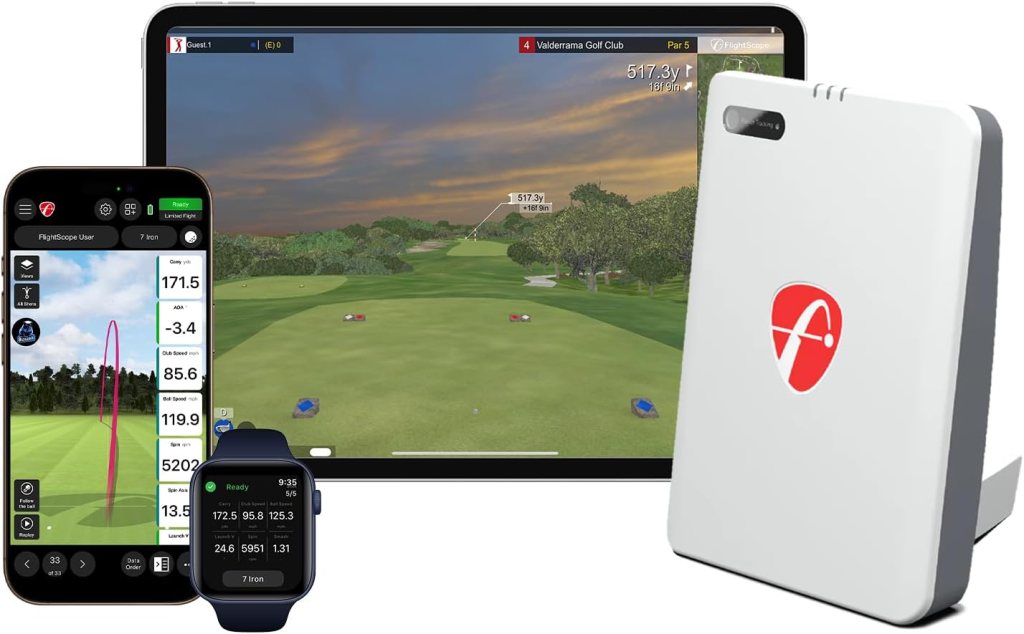
2. FlightScope Mevo Gen2 — Best Value Standalone Launch Monitor
Price: ~$1,299 (launch monitor only) | Full Package: ~$5,000–$6,200
The FlightScope Mevo Gen2 is the 2026 replacement for the beloved Mevo+, and it takes the most compelling mid-range launch monitor in the game and makes it better. The Birdie Report called the Mevo+ “the best in class at anything under $3k if not $10k” for accuracy — the Gen2 builds on that foundation with FlightScope’s Fusion Tracking technology, directly measuring 18+ parameters across full swing and short game.
The headline advantage over the Garmin R10 is data quality. The Mevo Gen2 includes eight club metrics: club path, face angle, attack angle, and more — parameters that the R10 calculates through algorithms rather than measuring directly. For a golfer working with an instructor or committed to self-improvement through data, that difference is significant. The Gen2 also comes with zero mandatory subscription fees: a lifetime 8-course bundle on E6 Connect is included, and GSPro compatibility requires no recurring payment. The Full Swing KIT retails at $4,999 and provides 30 total data parameters. The fully loaded Mevo Gen2 provides more total data parameters for thousands less — a comparison that Home Performance Lab called definitively in the Gen2’s favor.
The one notable limitation: the Mevo Gen2 requires 16 feet of room depth for full-flight driver shots, which rules it out for tight spaces.
Pros:
- 18+ directly measured parameters including full club data set
- No mandatory subscription fees — lifetime E6 bundle included
- Official GSPro compatibility with no recurring payment
- Fusion Tracking technology is lighting-agnostic — works indoors and outdoors
- Competes with $5,000+ units on accuracy at a fraction of the price
Cons:
- Requires 16 feet of room depth — unsuitable for tight spaces
- Metallic dot stickers on clubs required for full club data measurement
- $1,299 is the launch monitor only — full enclosure/mat/projector package adds significant cost
- Less polished native app experience than SkyTrak’s dedicated software
Best for: Serious golfers with adequate room depth who want the deepest data set at the mid-range price point with no ongoing subscription commitment.
3. SkyTrak+ (ST MAX) Complete Package — Best for Compact Spaces
Price: ~$2,800–$7,099 depending on package | Launch Monitor: ~$2,295
If your available simulator space is under 16 feet deep — the minimum the Mevo Gen2 requires — the SkyTrak+ (now marketed as the ST MAX) is the camera-based solution specifically designed for compact home setups. The SkyTrak+ uses dual technology combining photometric cameras with Doppler radar, which delivers accurate spin axis data that pure radar units can only estimate — particularly valuable for iron and wedge shots where spin rate and spin axis determine shot shape and stopping power.
Reviewers who’ve compared the SkyTrak+ against Foresight GC3 units side-by-side describe the iron data as “remarkably close,” which is high praise given the GC3’s $3,500 price tag. The SkyTrak app is the most polished native experience in the mid-range simulator market — clean interface, quick session start-up (1–2 minutes), and strong compatibility with E6 Connect and TGC 2019 software. The all-in-one ST MAX package at $7,099 includes the launch monitor, enclosure, projector, mat, and net — a complete setup that delivers a genuine simulator experience from a single purchase.
The subscription cost is worth noting upfront: the SkyTrak+ requires a minimum $129/year Essential plan or $249/year Game Improvement plan to access simulation and advanced data features. Over five years, that’s a real cost to factor into the total investment.
Pros:
- Best camera-based accuracy for compact rooms under 16 feet
- Dual photometric + radar technology captures accurate spin axis on all shots
- The most polished native app in the mid-range segment — quick, clean, reliable
- All-in-one ST MAX package provides everything needed in a single purchase
- Excellent compatibility with E6 Connect and TGC 2019 course software
Cons:
- Mandatory annual subscription ($129–$249/year) adds ongoing cost beyond hardware
- More expensive hardware than the Mevo Gen2 for a similar data output
- Camera technology struggles in outdoor use in direct sunlight
- Can only hit off mats (not natural turf) when used for indoor simulation
Best for: Golfers with basement or garage setups under 16 feet who want the best camera-based accuracy and the most polished simulator software experience in the mid-range.
4. Bushnell Launch Pro (Foresight GC3) — Best Mid-Range Accuracy
Price: ~$3,500 (launch monitor) | Full Package: ~$6,000–$8,000
The Bushnell Launch Pro is a Foresight GC3 with a Bushnell logo and a dramatically lower price tag — $3,500 versus the GC3’s $7,000+. It uses the same photometric camera technology as its Foresight counterpart, directly measuring ball and club data with a level of accuracy that reviewers consistently place above the Mevo Gen2 and SkyTrak+ in head-to-head testing. Most recently updated in 2026 with LINK-Enabled technology integration alongside the Bushnell rangefinder ecosystem, it’s the best accuracy-per-dollar in the $3,000–$4,000 price band.
For golfers who intend to use simulator data for fitting consultations, self-coaching against specific metrics, or comparison with instructor-grade equipment, the Launch Pro’s photometric accuracy is a meaningful step above radar-based alternatives. Indoor and outdoor performance are consistent — camera technology captures impact data directly rather than tracking flight, which eliminates the indoor accuracy degradation that affects radar units. The Pro Package subscription ($499/year) unlocks the full data set; base package already includes comprehensive ball and club metrics.
Pros:
- Same Foresight GC3 photometric technology at half the GC3 price tag
- Best accuracy in the $3,000–$4,000 price range — outperforms Mevo Gen2 and SkyTrak+ in head-to-head testing
- Consistent accuracy indoors and outdoors — camera captures impact, not flight
- LINK-Enabled Bushnell ecosystem integration with Pro X3+ rangefinder
- Trusted Bushnell/Foresight brand with established support infrastructure
Cons:
- $3,500 for the launch monitor alone — more expensive entry than SkyTrak+ or Mevo Gen2
- Pro Package subscription ($499/year) required to unlock the full advanced data set
- Primarily an indoor unit — outdoor use in bright sunlight can affect camera performance
- GSPro and TGC 2019 integration requires additional software purchases
Best for: Serious home simulators who want professional-grade photometric accuracy at mid-range pricing — golfers who take their data seriously and want results that hold up against fitting-studio equipment.
5. Uneekor EYE MINI — Best Premium Home Simulator Experience
Price: ~$4,500 (launch monitor) | Full Package: ~$7,500–$10,000+
The Uneekor EYE MINI is what you buy when the entry-level and mid-range options have been evaluated and the conclusion is: I want the best home simulator experience available without spending $20,000 on a Trackman. It’s a portable overhead optical unit — meaning it mounts above and in front of the hitting area, keeping the floor completely clean and eliminating any interference with the swing path — with a built-in touchscreen display, outstanding accuracy, and the View software platform, one of the most full-featured analytics suites available in any home simulator.
The EYE MINI handles left/right golfer switching seamlessly, which makes it ideal for households where multiple golfers of different handedness use the same setup. Shot feedback is fast and the data quality rivals fixed overhead systems costing twice the price. View software delivers practice analytics, shot tracking, and course play with a depth that no mobile-app-based mid-range unit can match. This is the simulator setup that makes the garage the best practice facility within 20 miles — and the one that pays back in game improvement data that rivals a professional coaching studio.
Pros:
- Overhead mounting keeps the swing path completely clear — no interference with any shot
- Built-in touchscreen display eliminates the need for a separate tablet or phone
- View analytics software is among the most comprehensive in home simulation
- Handles left-right golfer switching seamlessly — ideal for mixed-handedness households
- Data accuracy rivals fixed commercial overhead systems at a fraction of their cost
Cons:
- Most expensive option on this list at ~$4,500 for the launch monitor alone
- $199/year subscription required to access third-party simulation software like GSPro
- Permanent or semi-permanent installation required — not designed to be packed away
- Requires careful calibration on installation — not a plug-and-play experience
Best for: Dedicated home simulator builders who want the premium experience — the overhead unit that delivers commercial-facility accuracy in a home setting without the $20,000+ Trackman investment.
Buying Guide: What You Need to Know Before You Buy
Space: The Non-Negotiable Starting Point
Before selecting any launch monitor or software, measure your available space honestly. The minimum viable dimensions for a home simulator setup are:
- Room depth: 16 feet minimum for driver shots with a radar unit (Mevo Gen2, Garmin R10). Camera-based units like the SkyTrak+ work in as little as 10–12 feet.
- Width: 10 feet minimum to swing a driver without walls or shelving in your peripheral vision
- Ceiling height: 9 feet absolute minimum, 10 feet strongly recommended. You need to be able to swing your driver without any ceiling contact on a full follow-through. This is where most garage setups fail — check the ceiling height before purchasing.
Room under 14 feet deep? Buy a camera-based unit (SkyTrak+, Bushnell Launch Pro). Room 16 feet or deeper? Radar or hybrid units open up. Ceiling under 9 feet? Spend carefully — some golfers simply cannot fully swing in that height and are better served with a launch monitor for range use rather than a full simulator.
Radar vs. Camera Technology: Which Is Right for You?
Radar units (Garmin R10, Mevo Gen2, Full Swing KIT) sit behind the ball and track flight using radio waves. They’re portable, work in any lighting, and perform well outdoors. The trade-off: accuracy drops indoors where the ball hits a screen quickly, and short game data is less reliable. Best for outdoor range practice, budget setups, and portable use cases.
Camera (photometric) units (SkyTrak+, Bushnell Launch Pro, Uneekor EYE MINI) sit beside or above the ball and capture high-speed images at impact. They deliver consistent accuracy indoors regardless of flight distance and produce the most reliable spin data. The trade-off: they can struggle outdoors in bright sunlight and require controlled lighting indoors.
For a permanent home setup, camera-based is generally the better long-term investment. For a portable unit used primarily at the range, radar wins.
Software: The Experience That Determines Whether You Use It
The best launch monitor with bad software produces a setup you stop using. The major platforms in 2026:
GSPro is the most popular course simulation platform, with 140,000+ holes and a growing community. Compatible with most mid-range and premium launch monitors. One-time purchase around $200.
E6 Connect is the established commercial-grade platform with excellent visuals. Subscription-based ($200–$350/year) with 100+ courses and strong launch monitor compatibility.
TGC 2019 offers a large course library with realistic graphics. One-time purchase or subscription depending on the retailer.
Garmin Golf is a proprietary platform tied to Garmin’s ecosystem — 42,000+ courses but requires an ongoing subscription and is optimized for R10 and R50 units.
The recommendation for most home builders: prioritize GSPro compatibility and invest in the one-time license. It removes the annual subscription layer and gives you the largest course library available.
Total Cost of Ownership: Add Up the Real Numbers
Every simulator recommendation comes with the launch monitor price prominently displayed and the full cost of the enclosure, mat, projector, and software quietly omitted. The real cost breakdown for a complete home setup:
- Launch monitor: $499–$4,500
- Enclosure/net: $400–$2,000
- Impact screen: $300–$800
- Projector (short-throw): $500–$1,500
- Hitting mat: $150–$500
- Software/subscriptions: $0–$499/year
- Projector mount and cables: $100–$300
Total realistic ranges:
- Entry-level setup (Garmin R10): $1,500–$2,500 all-in
- Mid-range setup (Mevo Gen2 or SkyTrak+): $5,000–$8,000 all-in
- Premium setup (Uneekor EYE MINI): $9,000–$12,000+ all-in
Final Verdict
For entry-level home simulation, the Garmin R10 package is the easiest, most risk-free starting point — $499 for the launch monitor, a few hundred more for a net and mat, and you’re practicing with real data before the end of the weekend.
For the mid-range golfer who wants serious data depth with no subscription commitment, the FlightScope Mevo Gen2 is the best value in the market if your room is 16 feet deep. For compact spaces under 16 feet, the SkyTrak+ is the only full-featured camera solution that works and is worth the subscription cost for the polish of the native software experience.
For accuracy that rivals a fitting studio, the Bushnell Launch Pro is the best price-to-performance in the $3,500 range. And for the golfer who wants the complete premium experience without a Trackman price tag, the Uneekor EYE MINI is the setup that makes the garage the best room in the house.
The home simulator market in 2026 is the best it’s ever been for consumers. A $500 Garmin R10 delivers more data than equipment that cost $10,000 five years ago. Whatever your space and budget, the right setup is available — and once you’re hitting shots with real data at 10pm on a Tuesday, you’ll wonder how you ever practiced without it.
Low Handicap Golf may earn a commission through affiliate links on this page at no additional cost to you. All product recommendations are based on independent research and publicly available testing data. Prices shown are approximate and vary by retailer and package configuration.
 Low Handicap Golf
Leave a comment