
By Low Handicap Golf | Updated May 2026
Ask any scratch golfer where they spend most of their practice time and the answer is almost always the same: the short game area. Not the range, not the putting green — the area around the green where chipping, pitching, and bunker play intersect. The reason is simple math. Roughly 60–65% of all golf shots happen inside 100 yards. If your long game is average but your short game is sharp, you’ll outscore most golfers you play with. If your short game leaks shots, no amount of range work will paper over the damage.
This guide is the most complete short game resource on the site. It covers every element — chipping, pitching, bunker play, and putting — with the core technique, drills, and specific product recommendations that support improvement in each area. Read it front to back for the complete picture, or jump to the section where you’re losing the most shots.
Section 1: Chipping — Getting the Ball Rolling Quickly
The single best upgrade most golfers can make to their chipping is philosophical: stop trying to loft the ball to the hole and start trying to get it rolling. The longer the ball spends in the air on a chip, the more opportunities there are for it to land awkwardly, bounce unpredictably, and end up nowhere near where you intended. The bump-and-run — landing the ball a foot or two onto the green and letting it run to the hole — is the foundation of a reliable chipping game.
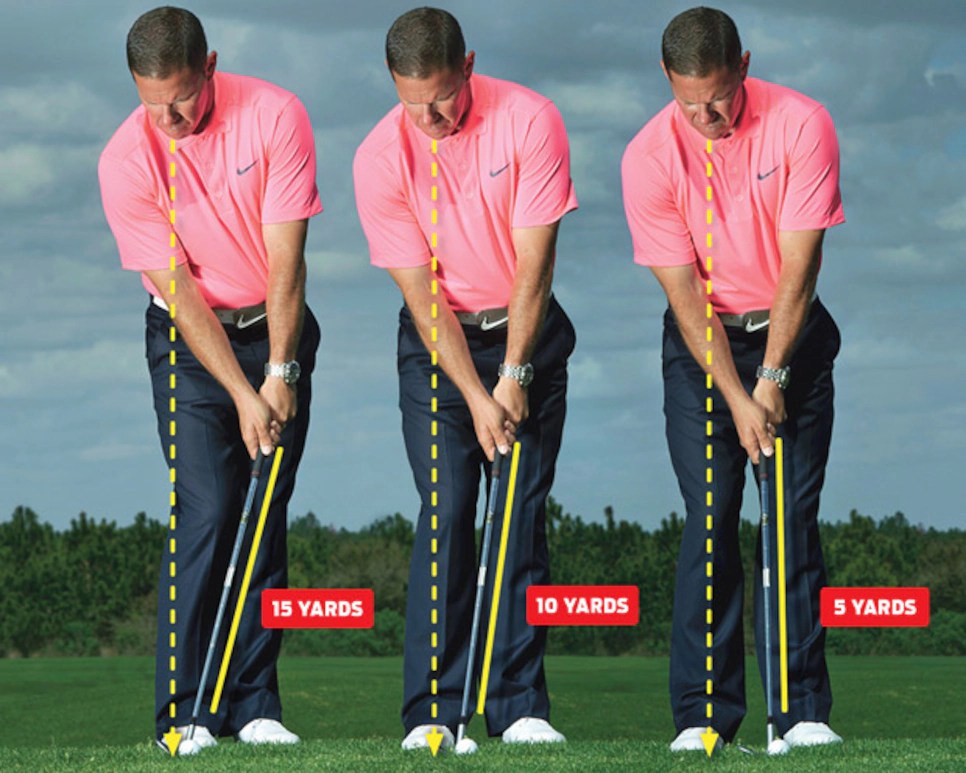
The setup: Play the ball back in your stance, hands forward, weight slightly left (60–65% on your front foot). This creates the descending strike that produces clean contact and predictable roll. The stroke is essentially a putting stroke made with a different club — no wrist manipulation, no independent arm swing, just a synchronized body and arm movement that brushes the turf through impact.
Club selection for chipping: Use the least loft you need to get the ball onto the green and rolling. A 7-iron or 9-iron bump-and-run from tight fringe is easier to execute and more predictable than a lob wedge from the same position. Save high-loft shots for situations where you genuinely need to carry an obstacle — a bunker, a ridge, a deep swale. On a flat chip with clear green between you and the flag, give yourself every chance to succeed by choosing the lower-trajectory option.
The key mistake: Most golfers flip the wrists through impact — the lead wrist breaks down, the club head passes the handle, and the result is thin chips that scurry across the green or heavy chunks. Keep the handle leading the club head through impact. This is the fundamental of clean chipping that everything else depends on.
Chipping Product Recommendations
Cleveland RTX 6 ZipCore Wedge (~$149) — The best-value wedge for chipping. The ZipCore technology provides genuine forgiveness on slight off-center chips around the green, and the feel through impact gives clear feedback on quality of contact. Available in multiple lofts and three grind options. Our top pick for greenside chipping versatility.
Callaway Opus SP Wedge (~$169) — Built for creative short game shots. The compact Shape 6 profile excels from tight lies, and the sole design handles multiple shot types — the standard chip, the bump-and-run, and the occasional flop — without requiring dramatic setup adjustments. Ideal for golfers who want one wedge to handle diverse chipping scenarios.
Titleist Vokey SM9 (~$139) — Smart money in the premium wedge market. The same six grind options as the SM10 at a meaningfully lower price. For dedicated chippers who want a fully fitted Vokey setup across a 52-56-60 configuration, the SM9 delivers excellent value relative to the SM10 while retaining everything that makes Vokeys the most-played wedge in the game.
Cleveland Chipper (~$79) — For golfers who struggle specifically with traditional chipping technique, a dedicated golf chipper eliminates most of the technique barriers. The chipper is designed to be used like a putter from just off the green, producing consistent low-trajectory shots that roll predictably to the hole. Not a substitute for developing real technique, but a useful tool for building confidence from tight chip positions.
Section 2: Pitching — Distance Control Inside 100 Yards
Where chipping is about getting the ball onto the green and rolling, pitching covers the range of partial shots from roughly 20 to 80 yards — distances where you need some loft, some spin, and real distance control. This is the most neglected area in amateur practice and the area with the highest potential for rapid score improvement.
The three wedge distances: Every golfer who works on their short game should identify three reliable yardages with each wedge: full, three-quarter, and half swing. A golfer carrying a 54° and a 58° who can reliably produce six consistent distances has a complete pitching arsenal — something between 25 and 80 yards that lands close to any flag. Without this calibration, every pitch shot is a guess.
The clock system: The most useful framework for building consistent pitch distances is the clock system. Think of the swing as a clock face. A 7 o’clock backswing (hands to hip height) produces one distance. A 9 o’clock backswing (hands to shoulder height) produces another. A full swing is 10 or 11 o’clock. Practice these positions systematically, track distances, and build a personal yardage chart. This removes all estimation from inside 80 yards.
The key technique: In pitching, the lower body initiates the downswing — hips turning through, weight transferring to the front foot, the arms following rather than leading. The common error is a hands-first or arms-first downswing that throws the club at the ball from the top. Correct pitching produces a slightly descending strike with clean contact, controlled spin, and repeatable distance.
Pitching Product Recommendations
Titleist Vokey SM10 (~$189) — The benchmark performance wedge for pitch shots requiring precise spin and distance control. The Spin Milled grooves generate the most consistent spin rates in the game from partial shots, and the progressive CG placement means each individual loft behaves optimally. For golfers serious about their pitch game, nothing outperforms a properly fitted SM10.
TaylorMade Milled Grind 4 (MG4) (~$179) — Named best overall in Today’s Golfer’s 2026 wedge test. The Spin Tread technology excels specifically on the partial pitch shots where wet lies, early morning dew, and rough chips cause inconsistent spin with conventional wedge faces. If inconsistent distance control from damp conditions is a specific pain point, the MG4’s wet-lie performance is genuinely superior.
Precision Pro NX10 Rangefinder (~$219) — Not a wedge, but directly connected to pitch shot improvement: the fastest route to better distance control inside 100 yards is knowing your exact yardages from specific spots. The NX10’s slope-adjusted yardages remove the guesswork that makes partial wedge shots inconsistent. Knowing you’re at 68 yards rather than “somewhere in the 60–75 range” transforms partial swing calibration practice into productive, score-improving work.
SKLZ Gold Flex Tempo Trainer (~$49) — The pitching game is almost entirely about tempo and timing, and the Gold Flex’s flexible shaft forces the correct sequencing on partial shots. It’s excellent pre-round warm-up for pitch shots and highly effective for building the consistent tempo that translates to consistent distances under pressure.
Section 3: Bunker Play — Make Sand Your Friend
For most amateur golfers, the bunker is the most feared shot in golf. It doesn’t have to be. The greenside bunker shot is actually one of the more forgiving shots in the game when executed correctly — because you’re not even trying to hit the ball. You’re hitting the sand, and the sand moves the ball. The margin for error on the entry point is a full two to three inches behind the ball. That’s a much bigger target than the ball itself.
The setup: Open the clubface before you grip the club — rotating it clockwise so it points slightly right of the target. Open your stance so your feet and shoulders aim slightly left. This combination creates the sharp, cutting motion through the sand that produces the high, soft shot. The clubface points roughly at the target even though your body is aimed left. Dig your feet into the sand for stability.
The swing: Swing along your body line (left) while the face points at the target. Hit two to three inches behind the ball — picture an entry point in the sand rather than the ball itself. You’re throwing sand onto the green. The ball rides on that cushion of sand and lands softly. Follow through fully. Most bunker failures come from quitting on the shot — decelerating into impact rather than swinging through it.
The key mistake: Closing the clubface before the shot. Golfers who fear bunkers often de-loft the wedge by addressing the ball with a square or closed face, which causes the club to dig into the sand rather than skimming through it. The bounce of the wedge — the bottom of the sole — only works properly with an open face. Commit to that open face, trust the bounce, and swing through.
Bunker Product Recommendations
Titleist Vokey SM10 in High Bounce (~$189) — For bunker play, the specific grind and bounce spec matters. A high-bounce option (10-14°) is the correct setup for the soft, fluffy sand found on most courses. The sole skims through rather than digging, the face stays open through impact, and the ball exits with the soft, controlled trajectory greenside bunker shots demand. Get fitted for the right grind.
Cleveland RTX 6 ZipCore in Mid-High Bounce (~$149) — The most forgiving premium bunker wedge on this list. The ZipCore technology provides the closest thing to forgiveness in a bunker — off-center strikes still exit the sand with reasonable trajectory and distance. For golfers building bunker confidence from scratch, the RTX 6 ZipCore’s forgiveness is a genuine aid.
Tour Striker Smart Ball Training Aid (~$40) — Bunker failures often come from disconnection in the swing — the arms swinging without the body, causing deceleration and inconsistent entry points. The Smart Ball trains connected, body-driven rotation that produces consistent, committed swings through the sand. The same training tool we recommend for full swing work translates directly to bunker technique improvement.
Alignment Sticks (~$15–$25) — For bunker practice specifically: set one alignment stick along your toe line pointing left of target, and use it to confirm your stance is genuinely open. Most golfers who think they’re playing with an open stance are actually only slightly open — seeing the stick parallel to your feet is often a revelation. The $15 investment produces immediate bunker feedback that most golfers never get without a coach watching.
Section 4: Putting — Where Scores Are Finally Made
Putting is 40% of your score. Every statistic, every analysis, every professional coaching study confirms that the most efficient path to lower scores runs directly through the putting green. The average mid-handicapper three-putts four to six times per round. Eliminating two of those three-putts saves two shots — without changing anything about the full game.
The fundamentals: Eyes over the ball. Face square to the intended line at address. A stroke that keeps the face square throughout — minimal rotation, consistent tempo, and the face direction determining starting line. Putts miss in two ways: wrong line or wrong speed. Speed control — getting the ball close on long putts — is more valuable than holing more short putts. A putt that finishes three feet short never goes in. A putt that rolls two feet past always has the line right.
The pre-putt routine: Consistency of routine produces consistency of execution. Walk behind the ball, pick a target line, commit to it before you step in. Set the face to the line, then build your stance around the face — not the other way around. One practice stroke to calibrate speed, then start the stroke within a few seconds. Routines that are too long introduce doubt; routines that are too short skip the alignment step that determines starting direction.
Lag putting vs. short putting: Practice these separately because they require different mental approaches. Lag putting (25+ feet) is about speed control — get the ball within a two-foot circle and two-putt. Short putting (inside 6 feet) is about confidence and consistency — aim for the back of the cup, commit to the line, and make a decisive stroke. Most golfers over-practice short putts and under-practice lag putting. The three-putt almost always starts with a poor lag.
Putting Product Recommendations
Odyssey Ai-ONE Putter (~$199–$249) — The AI-designed insert produces consistent roll on off-center strikes, which directly reduces three-putts from lag putting by keeping the ball closer to the intended distance even on slightly mishit putts. Soft, confidence-inspiring feel, excellent alignment aids, and the technology that makes it most useful for eliminating the three-putt at the exact moment of impact.
Eyeline Golf Putting Mirror (~$30–$40) — The single highest-return putting investment available. Reveals eye position, shoulder alignment, and putter face angle at address in one portable tool. Multiple golfers describe seeing their setup issues for the first time as a revelation. If you haven’t used a putting mirror, there’s a reasonable chance your setup has alignment errors you’ve never identified. At $35, this is the smartest short game equipment purchase on the site.
PuttOut Pressure Putt Trainer (~$30–$40) — A parabolic curved surface that returns the ball to you if it has too much pace and stops it dead at the hole if the speed is perfect. For short putting practice, it gamifies the session and creates the slight pressure that builds real performance. Place it anywhere — your living room, office, or hotel room — and practice meaningful 5-foot putts any time you have ten spare minutes.
Garmin Approach S12 GPS Watch (~$199) — Indirectly connected to putting but directly connected to the strategic decisions that reduce three-putts: knowing the exact distance to the front, middle, and back of the green before an approach shot lets you select the landing zone that leaves the simplest first putt rather than the most aggressive one. A 15-foot uphill putt is significantly easier than a 20-foot downhill slider. The Garmin S12 delivers front-middle-back distances that help you select approach shots that set up manageable first putts.
Final Verdict
The short game isn’t one skill — it’s four distinct skills, each with its own technique, practice approach, and equipment. The golfer who makes meaningful progress in all four will lower their handicap faster than any long game improvement can deliver.
The roadmap is straightforward: get the ball rolling on chips rather than lofting it. Build three reliable yardages with each wedge for consistent pitching. Commit to open face and full follow-through in bunkers. And dedicate at least half of every practice session to putting, with specific focus on lag control and the alignment fundamentals that a $35 putting mirror can diagnose in seconds.
Every product recommendation in this guide is available through our affiliate links. Prioritize the putting mirror and alignment sticks first — the highest-return investments on this page — and work your way through the other recommendations as your game develops.
Low Handicap Golf may earn a commission through affiliate links on this page at no additional cost to you. All product recommendations are based on independent research and real-world testing.
 Low Handicap Golf
Leave a comment