
By Low Handicap Golf | Updated May 2026
Getting your first set of irons right is more important than most new golfers realize. The difference between a set that’s designed for beginners and one that isn’t isn’t just cosmetic — it’s functional. The right beginner iron forgives the mishits that are an unavoidable part of learning the game, gets the ball airborne with less-than-perfect contact, and keeps your scores from spiraling on the holes where you haven’t yet developed the technique to deliver a consistent strike.
The wrong irons — blades or compact players’ irons that demand precision — punish every mistake. A slightly thin 6-iron that skips along the ground instead of flying to the green isn’t a teaching tool. It’s a source of frustration that slows development and drives players away from the game.
The best beginner irons in 2026 are genuinely impressive. Manufacturers have poured serious technology into game-improvement designs, and the perimeter weighting, large sweet spots, and wide sole designs available to new players today are meaningfully better than anything available a decade ago. This guide covers the five best options in 2026, followed by a buying guide that explains exactly what to look for and why.
Our Top 5 Golf Irons for Beginners in 2026
1. TaylorMade Qi Max Irons — Best Overall Beginner Iron
Price: ~$1,099/set (4-PW, steel) | Handicap Range: 18+
TaylorMade’s mantra with the Qi Max irons is that “straight distance is the best distance,” and this is exactly what both models deliver. In a category crowded with competing claims, the Qi Max backs that marketing with genuine performance. The TaylorMade Qi Max is a marked improvement on its predecessor, banishing the slightly harsh feel of old and delivering blistering ball speeds with an easy-to-launch flight — a genuine contender for anyone looking for new game improvement irons in 2026.
The internal heel weighting promotes a draw ball flight, which is directly useful for the majority of beginners who fight a chronic slice — it provides built-in correction that works consistently through the set. The progressive offset and CG design means longer irons launch high and shorter irons feel more controlled, which is exactly the transition a developing ball-striker needs across the set. The ECHO damper removes the hollow-body harshness that plagued earlier TaylorMade game-improvement models, giving the Qi Max a noticeably improved feel.
For a beginner who wants the most complete combination of distance, forgiveness, and built-in slice correction in a single 2026 iron set, the Qi Max is the pick.
Pros:
- Best-in-class distance and ball speed for a game-improvement iron in 2026
- Internal heel weighting provides draw bias — genuinely useful for slice-fighting beginners
- Markedly improved feel over previous TaylorMade GI irons via ECHO damper
- Progressive offset and CG placement optimized across every iron in the set
- Named a must-try game-improvement iron by multiple 2026 reviewers
Cons:
- Draw bias is a double-edged sword — golfers who already hook the ball should avoid these
- Aesthetic is more generic cavity-back than premium-looking competitors
- Feel, while improved, still trails the Srixon ZXiR and Ping G440 in tactile feedback
- At $1,099, it’s a meaningful investment for a golfer still deciding if they’ll commit to the game
Best for: New golfers who fight a chronic slice and want the maximum forgiveness and distance available in a 2026 game-improvement iron set.
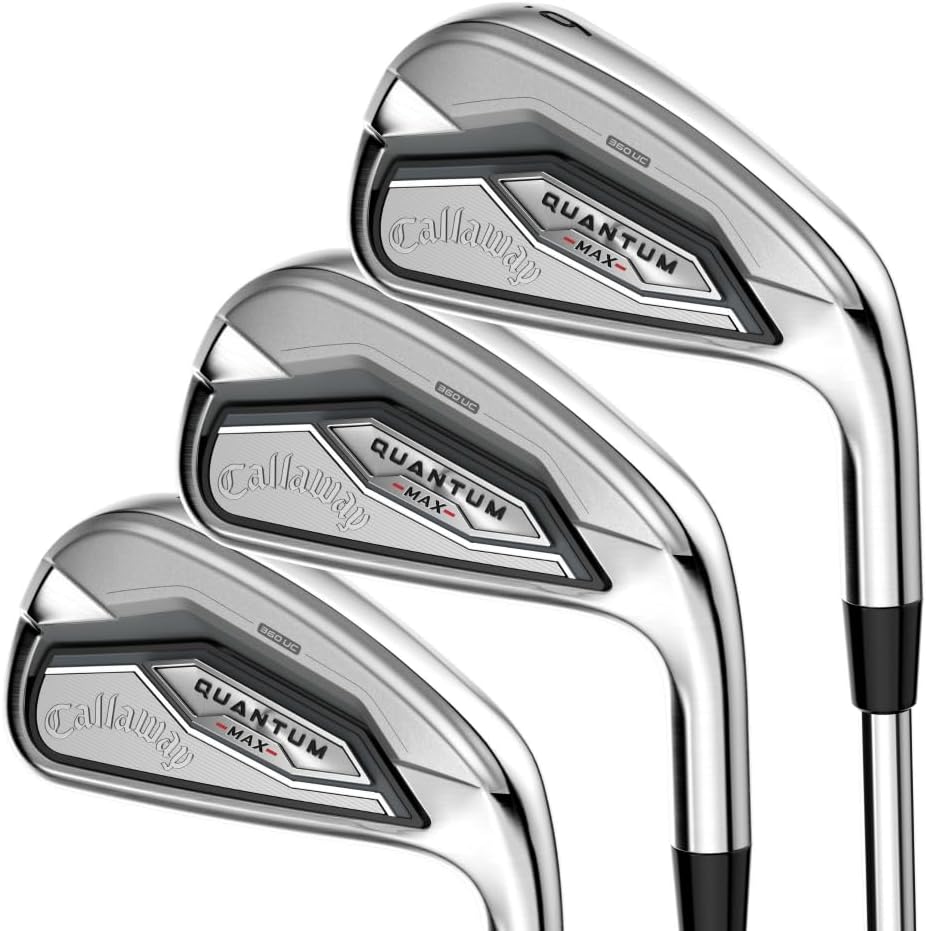
2. Callaway Quantum Max OS Irons — Best for Pure Forgiveness
Price: ~$999–$1,099/set (5-PW, AW) | Handicap Range: 18+
Callaway walked away from the hollow-body look of the Elyte and came back to the big cavity, confident shaping, and pronounced offset that defined their most popular irons of the 2000s. The Quantum Max looks like a game-improvement iron because that is exactly what it is — and you’ll feel the difference the moment it sits behind the ball. That’s not a criticism — it’s a statement of intent. Callaway designed the Quantum Max OS specifically to deliver maximum forgiveness without compromise, and it succeeds on those terms.
The AI-optimized face delivers faster ball speeds and more consistent launch, spin, and dispersion across the face. The oversized profile and extreme perimeter weighting through the 360° Undercut Cavity maximize MOI, meaning off-center strikes retain meaningful ball speed. The Progressive Tri-Sole Design adapts sole geometry from long irons to wedges for cleaner contact across the set — particularly valuable for beginners who struggle with the fat-shot disaster that comes from a wide sole catching the turf at the wrong angle. There is a clear message for who Callaway is targeting with the Quantum Max — going back to their roots with a clear game-improvement iron that is all about forgiveness.
Pros:
- Maximum forgiveness in the Callaway 2026 iron lineup — the OS designation means oversized
- AI-optimized face produces consistent ball speeds across a wide impact area
- Progressive Tri-Sole Design reduces chunking and promotes cleaner contact
- Clear visual confidence at address — the OS profile looks maximally forgiving behind the ball
- Strong Callaway brand backing and fitting infrastructure
Cons:
- Large, traditional cavity-back aesthetic won’t appeal to golfers who care about looks
- Feel is relatively poor across the face compared to premium competitors
- Not for golfers who are close to breaking 90 — the OS profile will become limiting
- The Callaway iron lineup can feel oversaturated — harder to navigate the model range
Best for: Beginners who want the absolute maximum forgiveness available in a name-brand iron set and are comfortable with a large, confidence-inspiring profile at address.
3. Ping G440 Irons — Best Beginner Iron for Long-Term Value
Price: ~$1,099–$1,199/set | Handicap Range: High handicap to mid-handicap
The Ping G440 Irons represent the sweet spot of the modern game-improvement market, delivering serious distance, high forgiveness, and premium aesthetics in a package that genuinely looks at home in the bag of a mid-handicap golfer. That last point matters for a beginner who plans to take the game seriously — the G440 won’t embarrass you as your game improves, and you won’t need to replace them for years.
A 9% thinner face, lower center of gravity, and new PurFlex Cavity badge produce elite ball speeds and a penetrating ball flight. The G440 HL version, tuned for slower swing speeds, is specifically worth considering for beginners who are still developing clubhead speed and need help generating launch. For players who know they’re serious and want equipment that fits them properly, the Ping G440 is worth every dollar — Ping’s fitting infrastructure is the best in the game and getting properly fitted for a set of G440s produces results that an off-the-rack purchase from any other brand can’t match.
The one caveat: beginning golfers who aren’t certain they’ll commit long-term to the game should start with a less expensive option. The Ping investment is rewarded by dedication, not casual play.
Pros:
- The best-looking game-improvement iron on this list — genuinely premium at address
- Forgiveness and distance performance that competes with anything in the category
- Grows with your game as you improve — won’t need replacing as handicap drops
- Ping’s fitting process is the industry standard — Dot system ensures correct specs for your swing
- The G440 HL version is purpose-built for slower swing speeds common in beginners
Cons:
- Most expensive option on this list — harder to justify for golfers new to the game
- Needs a proper Ping fitting to maximize value — off-the-rack purchase risks wrong specs
- Less draw bias than the Qi Max — not optimized specifically for slice correction
- Fitting appointment required to access the full value of the Ping Dot system
Best for: Committed beginners who plan to play seriously and want a set of irons that will carry them from high handicap into mid-handicap territory without replacement.
4. Cleveland Halo XL Full-Face Irons — Most Forgiving Beginner Iron Available
Price: ~$799–$1,099/set | Handicap Range: 20+
The Cleveland Halo XL is not designed for traditionalists. This is an iron built with one priority in mind: forgiveness. And for golfers who are completely new to the game — struggling with basic contact, getting the ball airborne, and avoiding the chunked iron that travels 40 yards — the Halo XL is the set that removes more barriers than anything else on this list.
The Halo sole is wider than any other iron in this comparison — it creates a cushion of metal behind the leading edge that prevents the fat-shot disaster from happening as catastrophically. For beginners who are just learning the downward strike motion that produces good iron contact, the Halo sole is like having training wheels built into the club. Bad shots still happen, but they’re survivable. Full-face grooves, a first for irons in the industry, provide consistent performance regardless of where on the face the ball is struck — a genuinely meaningful feature for a beginner who hits the ball in different locations on every swing.
The trade-off is aesthetic and eventual: the Halo XL’s oversized, hybrid-like profile will feel limiting once a golfer’s game develops, and it won’t grow with you as effectively as the Ping G440. But as a learning tool for the first year of golf, it’s the most forgiving iron ever built.
Pros:
- Most forgiving beginner iron available — Halo sole prevents catastrophic fat shots
- Full-face grooves deliver performance regardless of vertical impact location
- Hollow-body construction maintains ball speed on mishits that would kill other irons
- Lower price point than Ping and TaylorMade alternatives
- Confidence-inspiring at address — the large profile removes doubt before you swing
Cons:
- Hybrid-like profile looks more like a game-improvement club than an iron — polarizing aesthetic
- Will eventually be outgrown — not the right set to carry into mid-handicap territory
- Less suitable for golfers who already have some swing consistency and want a longer-term investment
- The extreme forgiveness masks feedback that helps you learn what good contact feels like
Best for: True beginners in their first year of golf who need maximum help with fat shots and airborne ball flight above everything else.
5. Srixon ZXiR HL Irons — Best Beginner Iron for Feel and Premium Looks
Price: ~$999/set | Handicap Range: High handicap to mid-handicap
Srixon’s ZXiR range takes a brand known for making premium tour-level irons properly into the game-improvement iron category, offering a premium look and feel akin to the tour-tested ZXi range while generating much more forgiveness for a wider range of players. For beginners who want to avoid the generic look of most game-improvement irons — the large, chunky profiles that announce “beginner” to every playing partner — the ZXiR HL is the answer.
The new iALLOY material provides a genuinely different feel from other game-improvement irons — softer and more premium-feeling than the hollow-body alternatives — while the MainFrame milling pattern positions forgiveness support specifically at the low face area where high-handicappers most commonly make contact. The Tour V.T. Sole ensures the club keeps generating speed through the turf even from imperfect lies. The ZXiR HL is what you recommend to the golfer who wants game-improvement performance in a package that doesn’t look like a game-improvement iron. It’s among the best-looking irons on this list regardless of handicap category.
Pros:
- Premium ZXi-inspired aesthetics — the best-looking iron on this list for a beginner
- iALLOY material delivers a softer, more premium feel than hollow-body competitors
- MainFrame milling concentrates forgiveness support at the low face where beginners make contact
- Tour V.T. Sole maintains speed through imperfect lies and heavy turf interaction
- Grows more comfortably into mid-handicap territory than the Halo XL or Quantum Max OS
Cons:
- Less raw forgiveness than the Callaway Quantum Max OS or Cleveland Halo XL
- Less draw bias than the TaylorMade Qi Max — not purpose-built for slice correction
- Srixon brand recognition lower than TaylorMade, Ping, and Callaway in the beginner market
- Less widely available for fitting than Ping or TaylorMade alternatives
Best for: Style-conscious beginners who want premium aesthetics alongside genuine game-improvement forgiveness, and who plan to improve steadily toward single-digit territory.
Buying Guide: What Beginners Should Look For in Irons
Forgiveness: The Single Most Important Spec
Ideally a beginner’s iron should act as a stabilizer for your swing. By positioning weight around the perimeter of the clubhead — a concept known as perimeter weighting — manufacturers create a design that better resists twisting on heel and toe strikes. The result is improved forgiveness, helping preserve ball speed and distance on mishits so your yardages remain more consistent even when contact is less than perfect.
Every iron on this list uses perimeter weighting as a core design principle. The spectrum runs from maximum forgiveness (Cleveland Halo XL, Callaway Quantum Max OS) to premium-feeling forgiveness with better aesthetics (Srixon ZXiR HL, Ping G440). Where you sit on that spectrum depends on how new you are to the game — the more inconsistent your ball-striking, the more forgiveness matters relative to everything else.
MOI (Moment of Inertia) is the specific measurement of forgiveness: higher MOI means the club head resists twisting more on off-center strikes, which keeps the ball flying straighter and further than it otherwise would. When comparing irons, MOI is the number that matters most for beginners.
Shaft Flex: Getting This Wrong Is the Most Common Equipment Mistake
Most beginner golfers — and many equipment retail staff — underestimate the importance of shaft flex. A shaft that’s too stiff for your swing speed produces pushes and slices because the face doesn’t square at impact. A shaft that’s too soft produces hooks because the head overtakes the hands. Either issue, on a swing that’s already developing inconsistency, makes improvement harder.
As a general guide for beginners:
- Regular flex: swing speeds around 75–90 mph — the most common choice for male beginners
- Senior flex: swing speeds under 75 mph — appropriate for many beginners, especially those over 50
- Ladies flex: swing speeds under 65 mph
The vast majority of beginner iron sets are available in graphite shafts, which are lighter and easier to swing than steel. For golfers with slower swing speeds or those who want to reduce fatigue, graphite is the correct shaft material. If your swing speed is above 90 mph and you prefer a stiffer response, steel in regular or stiff flex is appropriate.
If in doubt: get a fitting or visit a launch monitor. Knowing your actual swing speed removes all the guesswork.
Set Composition: Start at the 5-Iron (or Skip to Hybrids)
Modern iron set configurations have moved away from the 2-iron, 3-iron, and 4-iron for good reason: they’re extremely difficult to hit consistently for most golfers, and hybrids covering the same distances are dramatically more forgiving. Configure your iron set starting at the 5-iron or 6-iron, and use hybrids for the longer shots.
Most beginner sets on this list start at the 5-iron and include through to a pitching wedge or approach wedge. This is the correct starting configuration. If your package includes a 3-iron or 4-iron, leave them at home until your swing speed and ball-striking consistency develop — you’ll get better results from a hybrid in those positions.
A complete beginner setup typically looks like: Driver, 3-wood or 5-wood, 4-hybrid or 5-hybrid, 5-iron through pitching wedge, sand wedge, putter. That’s 13 clubs — one short of the 14-club limit — and a configuration that gives you a usable club for every distance without anything you’ll struggle to hit.
Budget: How Much Should a Beginner Spend on Irons?
The honest answer is: enough to get a quality game-improvement iron, not so much that a bad purchase stings. The $800–$1,100 range covers every iron on this list and represents the sweet spot — below this range, quality and forgiveness drop meaningfully; above it, you’re paying for premium fit and finish that a beginner can’t yet use.
If the budget is genuinely tight, quality certified pre-owned sets from the previous generation (Callaway Rogue ST Max, Ping G425, TaylorMade Stealth) represent excellent value and deliver performance that will outclass any new set in the $400–$600 range.
Final Verdict
For most beginners in 2026, the TaylorMade Qi Max is the strongest all-around choice — the best combination of distance, forgiveness, and built-in slice correction in the category. For pure maximum forgiveness, the Cleveland Halo XL Full-Face is the most protective beginner iron ever built. For a set that will grow with you as your game improves toward single digits, the Ping G440 is the long-term investment worth making from the start.
On a premium budget with an eye toward looks and feel, the Srixon ZXiR HL is the best-looking game-improvement iron on the market. And for the highest forgiveness available in the Callaway range, the Quantum Max OS delivers maximum perimeter weighting in a trusted name-brand package.
Whatever you choose: prioritize the fitting session over the model selection. The right shaft flex and lie angle for your swing is worth more than any single technology feature in any iron set.
Low Handicap Golf may earn a commission through affiliate links on this page at no additional cost to you. All product recommendations are based on independent research and publicly available testing data.
Leave a Reply