
By Low Handicap Golf | Updated May 2026
Putting accounts for roughly 40% of your score, and most of that isn’t a mechanics problem — it’s a reading problem. The golfer who three-putts from 25 feet almost always had the right stroke. They had the wrong line. They misread the slope, underestimated the speed, ignored the grain, or committed to a break that wasn’t there. Then they stood over the putt with a line in their head and made a perfectly executed stroke that went nowhere near the hole.
Tour professionals don’t make putts because they stroke it better than you. The gap in putting performance between a scratch golfer and a tour pro on a launch monitor is far smaller than the gap on the scorecard. What tour professionals do better is read greens — systematically, thoroughly, and before they ever step into their stance. They have a process. Most recreational golfers have a glance.
This guide covers the four key variables in every green-reading situation — slope, grain, speed, and break — along with a practical process for reading greens more effectively and the training tools that accelerate improvement. Master this, and you’ll find putts dropping that used to slide past the edge.
Section 1: Reading Slope — Start From 30 Feet Back
Slope is the primary variable in every green-reading situation, and the most important thing to understand about reading slope is where to read it from. Most golfers walk to their ball and crouch behind it. Tour caddies and pros start their read from 30 to 40 feet behind the ball, low to the ground, looking down the entire putting corridor from ball to hole.
From that distance, the overall contour of the green is visible in a way it simply isn’t from address. You can see whether the land rises or falls between ball and hole, where the highest point of the green is, and how the surrounding terrain — the hills, the bunkers, the course drainage direction — affects the slope on the putting surface. These macro-level reads inform every specific line decision that follows.
The second read is from behind the hole, looking back toward the ball. This gives you the opposite perspective and often reveals a subtle slope that wasn’t obvious from the ball side. On significant breaking putts, the slope visible from the hole side often looks more dramatic — which is closer to what the ball actually experiences as it slows near the cup.
The third read is from the low side of the putt, looking across the slope. This is the perspective most golfers skip, and it’s where the true break often reveals itself most clearly. Standing at the midpoint of the putt on the low side and looking across gives you the clearest view of how much the land tilts between your ball and the hole.
The practical process: walk the green before you mark your ball. Read from all three positions — behind the ball, behind the hole, from the low side. Form your line conclusion before you step into your stance, so you’re committing to a read rather than second-guessing one.
Section 2: Reading Grain — The Overlooked Variable
Slope is the variable most golfers think about. Grain is the variable most golfers ignore — and in certain conditions and on certain grasses, grain can affect a putt almost as much as slope does.
Grain refers to the direction the grass grows. Bent grass, which is common on courses in cooler climates, has relatively little grain effect. Bermuda grass, which dominates courses in the southern United States, coastal regions, and tropical climates, can have dramatic grain influence that overrides slope on short-to-medium putts.
The rules for reading Bermuda grain are straightforward once you know them.
Shiny vs. dull appearance: Looking at the putting surface, if the grass appears shiny and bright, you’re looking downgrain — the grass is growing toward you. Putts hit in this direction will roll faster than the surface speed suggests. If the grass appears dull and dark, you’re looking into the grain — the grass is growing away from you. Putts hit into the grain will roll slower and require more pace than expected.
The direction of grain growth: Bermuda grass on most courses grows in a consistent direction — toward the afternoon sun (typically west), toward water sources, or in the direction of the prevailing drainage. Once you identify the dominant grain direction on the first or second hole, it’s relatively consistent across the course. Learning that a specific course drains to the northwest means you can anticipate grain across every hole without needing to read each green fresh.
Around the cup: Grain is most visible around the cup itself. Look at the edge of the hole — if the grass is lying toward one side of the cup, the grain runs that direction. On a putt that breaks toward grain, the breaking action is amplified. Against grain, it’s reduced.
Section 3: Reading Speed — The Variable That Changes Everything
Line and speed are not independent variables. They’re deeply connected. A putt rolling at pace dying into the cup takes the high line — the apex of the break — and needs to be aimed significantly outside the hole to account for the full breaking action. The same putt hit firmly, running through the hole area at a faster pace, plays much less break because it has less time to deviate and is less affected by subtle contours.
Tour professionals make a specific decision on every putt before they step into their stance: am I dying this putt into the cup, or am I hitting it with some pace? That decision determines the line, not the other way around.
For recreational golfers, the most reliable approach is to play to die the ball into the cup on breaking putts — this maximizes the size of the effective target (the full front-to-back depth of the cup) rather than restricting it to the back of the cup with a firm putt. The trade-off is that die putts require precise speed control — too slow and the ball doesn’t reach, too fast and it doesn’t break enough.
Speed calibration for a new course starts on the practice green. Hit three or four 40-foot putts with no specific target, focusing entirely on pace — the goal is to have the ball stop 6 to 12 inches past the hole position. This gives you a baseline feel for how the greens run, which you then carry onto the course. Greens that are fast need less stroke length and more aggressive break-reading. Slow greens need more pace and play less break. Know which one you’re on before hole 1, not hole 10.
Section 4: Reading Break — Building the Complete Picture
Break is the output of slope, grain, and speed combined. Once you understand each component individually, reading break becomes a synthesis exercise rather than a guess.
The one universal principle of break that every serious putter understands: always play more break than you think. The most common three-putt miss is the putt that starts on the correct line and slides past the low side of the hole — the amateur’s side, as it’s sometimes called. The ball never went through the hole. It couldn’t — it was always below it. Amateur golfers systematically underestimate break, particularly from longer distances where the full curvature of a putt is harder to visualize.
The correction isn’t complicated: take your read, then add 20%. If you think the putt breaks six inches, play it for eight. If it breaks a full cup, play it for a cup and a half. The worst case is a miss on the high side, which still leaves an uphill tap-in. The miss on the low side never had a chance.
On severely breaking putts — the dramatic sidehill 20-footers that run across significant slope — tour professionals often pick an intermediate target on the green and aim for that point rather than the hole. The putt becomes two segments: a straight putt to the intermediate target, which then curves to the hole. This approach simplifies the mental task and makes commitment easier than trying to visualize the full arc of a dramatic break.
Section 5: Tools That Train Better Green Reading
Understanding the theory of green reading improves your decision-making. Training tools build the physical skills — alignment, stroke consistency, speed control — that convert good reads into made putts.
1. Eyeline Golf Putting Mirror — Best for Alignment Training
Price: ~$30–$40
Green reading only pays off if you can actually align the putter face to your intended line at address. The Eyeline Golf Putting Mirror is the most effective training tool for this specific skill — it gives you an exact visual check on eye position over the ball, shoulder alignment, and putter face angle simultaneously. The gate slots create a physical target that the putter must pass through on a true path. Many golfers discover for the first time — when they look in the mirror — that their eyes are behind the ball rather than over it, or that their shoulders are open to the target line in a way that’s been causing misses they attributed to a bad read. Use this on your home putting mat before rounds to ingrain the setup that converts good reads into accurate starting lines.
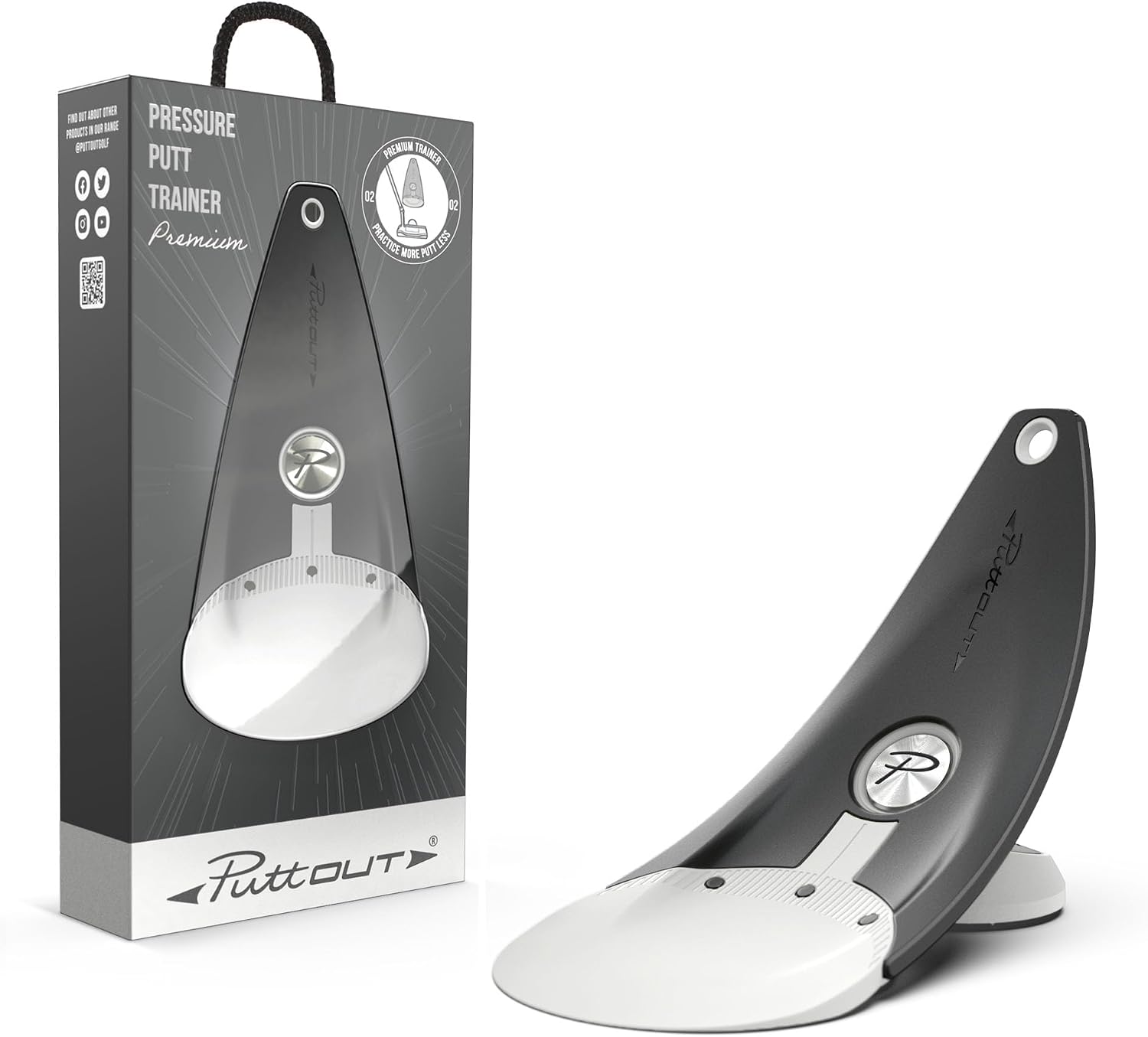
2. PuttOut Pressure Putt Trainer — Best for Speed Control Practice
Price: ~$30–$40
Speed control is the most neglected putting skill and the most directly connected to green-reading effectiveness. A putt that’s aimed at the right line but hit at the wrong pace still misses — and the miss teaches you nothing about your read. The PuttOut Pressure Putt Trainer creates an infinitely returning practice target that accepts only putts with perfect pace — the ball returns to exactly the distance short of the target that it would have finished past the hole. Too hard, it comes back long. Too soft, it stops short. This immediate pace feedback is genuinely useful for calibrating speed control before rounds and developing the consistent distance management that makes aggressive break-reading viable.
3. Odyssey Ai-ONE Putter — Best for Consistent Roll
Price: ~$199–$249
A putter that starts the ball on your intended line consistently is the mechanical foundation that green-reading accuracy requires. The Odyssey Ai-ONE’s AI-designed insert normalizes ball speed across the face — off-center strikes produce a roll that deviates less from the intended line than a conventional face insert allows. For the golfer who reads greens correctly but still misses putts slightly offline due to inconsistent face contact, the Ai-ONE insert is a genuine mechanical improvement. The face technology won’t fix a bad read, but it makes sure that a good read isn’t wasted by a mis-strike that sends the ball an inch off the intended line from a 15-footer.
4. AimPoint Express — Best Green Reading System
Price: Free to learn (clinics ~$30–$50)
AimPoint Express is the green reading system used by professional golfers including Adam Scott, Stacy Lewis, and Charley Hull. The method uses your feet to physically feel the slope percentage of the putting surface, then converts that slope reading into a specific number of fingers held at arm’s length from the target — creating a visual reference for the apex of the break. The result is a systematic, repeatable read that eliminates the subjective guessing that plagues traditional green reading.
AimPoint clinics are offered at many golf facilities and teach the full system in a two to three hour session. At $30–$50 for a clinic — some are free as course promotions — it’s the highest-return green reading education available for the price. The system has a learning curve, but golfers who commit to it consistently report dramatic improvements in break accuracy within a few rounds of application.
Tying It All Together: The Pre-Putt Routine
Every element of green reading — slope, grain, speed, break — should feed into a consistent pre-putt routine that you complete before stepping into your stance. Improvised green reading, where you gather information and make decisions simultaneously while standing over the ball, produces inconsistent results. A systematic approach produces repeatable ones.
The routine that works: read from behind the ball first, then behind the hole, then from the low side if time permits. Decide on the pace — dying into the cup or hitting with some firmness. Commit to a break based on the read and add 20%. Pick an intermediate target on the green for breaking putts. Step in, set the face to the line, take one practice stroke for pace calibration, and start the ball within five seconds.
The worst putting routine is an extended one that allows doubt to accumulate. Gather information efficiently, make a decision, commit fully, and execute. Tour professionals make this look effortless because the system is ingrained — every variable gathered, synthesized, and resolved before they step into the stance.
Final Verdict
Reading greens well is a learnable, improvable skill — not an innate talent that some golfers have and others don’t. The golfer who approaches every green with a systematic process, reads slope from multiple angles, accounts for grain on Bermuda surfaces, calibrates speed on the practice green, and adds 20% to every break estimate will consistently outperform their natural ability on the putting surface.
Train the physical skills with the Eyeline Putting Mirror and PuttOut Trainer. Develop the mechanical consistency with the Odyssey Ai-ONE. Invest a morning in an AimPoint clinic and commit to the system for a full season. The putts that have been sliding past the low edge of the hole for years will start finding the back of the cup — and when they do, the game changes faster than any equipment upgrade will ever deliver.
Low Handicap Golf may earn a commission through affiliate links on this page at no additional cost to you. All product recommendations are based on independent research and real-world testing.
Leave a Reply