
By Low Handicap Golf | Updated May 2026
If you’ve been playing golf without a rangefinder, you’ve been playing with an unnecessary handicap. Not the kind on your card — the kind where you stand 155 yards from the flag, guess it’s “around 7-iron distance,” swing with uncertainty, and watch the shot come up 12 feet short of the green because you were actually at 163 yards. That uncertainty ripples through every shot. It changes how you commit. It costs strokes, slowly, round after round.
A rangefinder fixes that. And for a beginner, the benefits are even greater than for an experienced player — not just because accurate yardages help club selection, but because knowing your exact distances accelerates the feedback loop that lets you learn how far you actually hit each club. You can’t calibrate your game if you’re always guessing your starting distance.
The good news for first-time buyers is that the budget rangefinder market in 2026 is excellent. The accuracy gap between a $130 rangefinder and a $400 Bushnell has closed significantly. You don’t need to spend a fortune to get reliable yardages that will legitimately improve how you play. You just need to know what actually matters — and what’s just spec-sheet noise.
These are the five best laser rangefinders for beginners in 2026, chosen specifically for ease of use, accuracy at accessible price points, and value that makes the first-time purchase easy to justify.
Our Top 5 Beginner Golf Rangefinders in 2026
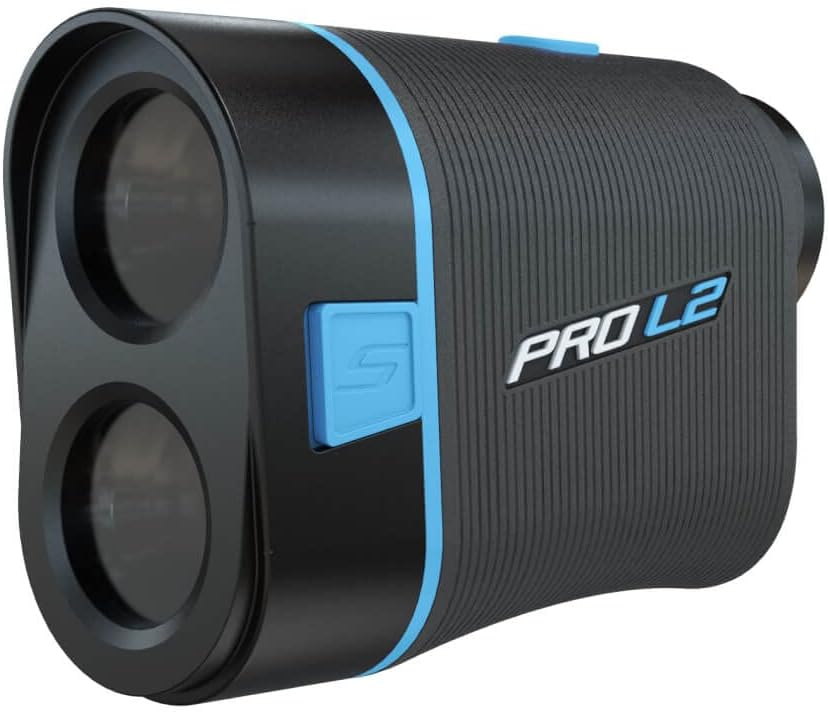
1. Shot Scope Pro L2 — Best Overall Budget Rangefinder
Price: ~$150 | Accuracy: ±1 yard | Slope: Yes (switchable)
The Shot Scope Pro L2 is the best rangefinder under $200 for a first-time buyer, and multiple independent 2026 testers back that assessment. Golf Insider UK ranked it the top pick in their comprehensive budget rangefinder test, and in head-to-head accuracy comparisons against significantly more expensive Bushnell models it consistently came within a yard of its more expensive rival across 18 holes of real-world testing.
The Pro L2 hits every feature that matters for a beginner: adaptive slope technology that adjusts yardages for elevation changes, a target-lock vibration that confirms when the laser has acquired the flag rather than a tree behind it, a built-in cart magnet that keeps it accessible without digging through your bag on every shot, and a switchable slope mode that makes it tournament-legal when you need it. The adjustable focusing ring is a practical touch that’s rare at this price — it lets you adapt the optics to your eyesight rather than accepting a one-size display.
At roughly two-thirds the length of a smartphone and half the width, it’s genuinely compact and easy to use one-handed. For a beginner building the habit of using a rangefinder on every approach shot, the Pro L2’s usability and accuracy make that habit formation frictionless.
Pros:
- Best accuracy-to-price ratio in the budget rangefinder category for 2026
- Built-in cart magnet — keeps the device accessible without manual re-casing
- Adaptive slope technology adjusts for elevation — switchable for competition
- Target-lock vibration confirms flag acquisition clearly
- Adjustable focusing ring accommodates different eyesight prescriptions
Cons:
- Flag lock can be slower than premium models on tree-lined holes beyond 150 yards
- Build quality, while solid, is a step below premium Bushnell or Blue Tees construction
- 6x magnification trails the 7x found on some competitors at similar price points
- No magnetic case for quick access — supplied case is standard pouch style
Best for: First-time buyers who want the best all-around accuracy and feature set at the most competitive price in the 2026 beginner rangefinder market.
2. GolfBuddy Laser Lite 2 — Best Compact Beginner Rangefinder
Price: ~$150 | Accuracy: ±1 yard | Slope: No
The GolfBuddy Laser Lite 2 spent two years as the top-ranked budget rangefinder in Golf Insider UK’s independent testing, and it remains one of the most consistently recommended compact rangefinders available in 2026. The pin finder mode is reliable even on tight, tree-lined holes where background interference gives cheaper rangefinders trouble, and the compact form factor makes it the most carry-bag-friendly option on this list — smaller and lighter than the Shot Scope Pro L2, which matters over a four-hour walking round.
Accuracy across testing is excellent — consistently within a yard across all distances — and the optics are noticeably clear at 6x magnification, performing well in both bright afternoon sun and overcast morning conditions. The vibration confirmation on flag lock is strong and decisive.
The one honest limitation: no slope mode. For a beginner playing casual rounds on courses with significant elevation change, missing the plays-like distance means you’re still estimating the adjusted yardage manually. For flat courses and beginners who don’t yet rely heavily on slope data, this is a non-issue. For anyone who plays hilly courses regularly, the Shot Scope Pro L2 or Blue Tees Series 3 Max are the better choices.
Pros:
- The most compact and lightweight rangefinder on this list — ideal for carry bag golfers
- Excellent pin finder mode handles tree-lined courses better than most at this price
- Strong vibration confirmation makes flag lock unmistakable
- Clean, clear optics that perform reliably in variable light conditions
- Consistently accurate to within a yard across all tested distances
Cons:
- No slope mode — a meaningful limitation on hilly courses
- No magnetic mount — rules it out for cart golfers who want quick access
- The pouch case that replaced the original hard case is a step backward in quality
- Fewer features than the Shot Scope Pro L2 at a similar price point
Best for: Carry bag golfers who want the most compact, lightweight beginner rangefinder with excellent accuracy and pin-finding performance — and who don’t need slope adjustment.
3. Blue Tees Series 3 Max — Best Style and 7x Magnification
Price: ~$179 | Accuracy: ±1 yard | Slope: Yes (switchable)
We’ve covered the Blue Tees Series 3 Max+ extensively in our Best Rangefinders Under $200 guide, and it earns a spot here too because it occupies a specific position that no other beginner rangefinder fills: the best-looking, clearest-viewing option in the budget category. The 7x magnification is a full step up from the 6x found on every other device on this list — the difference in view clarity and target acquisition is immediately noticeable when you pick it up, particularly on approaches beyond 150 yards where smaller targets become harder to resolve through lesser optics.
Golf Insider UK testing rated the Blue Tees accuracy at 9.4 out of 10 — excellent in the budget field — and the branding and build quality are genuinely premium-feeling for the price. The Series 3 Max includes slope with a switchable tournament-legal toggle and a magnetic strip on the body. For a beginner who wants a device that looks and feels like a premium product while staying well under $200, the Blue Tees Series 3 Max stands apart from the field.
Pros:
- 7x magnification is the clearest view on this list — noticeably better target resolution
- Best styling and build feel of any budget rangefinder in 2026
- Excellent 9.4/10 accuracy rating in independent head-to-head testing
- Slope with switchable toggle — full competition-legal capability
- Magnetic strip for cart attachment included
Cons:
- Slightly more expensive than the Shot Scope Pro L2 and GolfBuddy Lite 2 at $179
- The Blue Tees brand is newer — less established retail presence for in-person returns
- Supplied case is basic for a device with premium styling ambitions
- 7x magnification requires steadier hands — can exaggerate any shake in the image
Best for: Beginners who want the best visual experience and premium aesthetics in a sub-$200 rangefinder — and who don’t mind paying a small premium for the clearest view in the budget category.
4. TecTecTec KLYR — Best for Speed and Quick-Access Carry
Price: ~$169 | Accuracy: ±1 yard | Slope: No
The TecTecTec KLYR earns its reputation through one standout quality: flag lock speed. The near-instant acquisition on the KLYR is genuinely impressive at this price point — you raise it, point it, it vibrates, and you have your number before golfers with slower rangefinders have finished acquiring the target. For a beginner developing the habit of measuring every shot, that speed removes friction that slow devices can create. When using a rangefinder is instant and effortless, you use it more consistently.
The magnetic belt clip case is the most practical carry solution on this list — it clips to your belt or bag strap and snaps the rangefinder in and out with one hand. For golfers who want their rangefinder accessible without any case unzipping or re-holstering, the KLYR’s carry system is genuinely ahead of the field at this price. Accuracy is excellent inside 150 yards, with a slight drop-off in consistency at longer distances — a trade-off that comes with the speed-optimized design that makes it so fast at flag acquisition.
Pros:
- Fastest flag lock of any rangefinder on this list — near-instant acquisition
- Magnetic belt clip case is the most practical carry system at any budget price point
- Compact, lightweight design sits naturally in one hand
- Reliable accuracy inside 150 yards — covers the vast majority of approach shots
- Distinctive design stands out on the course
Cons:
- No slope mode — the same limitation as the GolfBuddy Lite 2
- Accuracy can be slightly inconsistent beyond 150 yards
- For maximum accuracy at all distances, the Shot Scope Pro L2 is the better pick
- Less vibration feedback strength than the Shot Scope and GolfBuddy alternatives
Best for: Quick-playing carry bag golfers who want the fastest flag lock available at the budget price tier and value the magnetic belt clip carry system above slope features.
5. GoGoGo Sport VPro — Best Entry-Level Rangefinder Under $100
Price: ~$80–$90 | Accuracy: ±1 yard (99.24%) | Slope: Yes (switchable)
The GoGoGo Sport VPro exists at a price point that makes the “should I even buy a rangefinder?” question irrelevant. At under $100, it’s the most affordable device on this list with independently tested accuracy of 99.24% — ahead of what the price would suggest, and reliable enough for the casual golfer or the complete beginner who wants to test whether they’ll actually use a rangefinder before committing to a $150+ option.
The standout feature for the price is the rechargeable battery via USB-C — no hunting for CR2 lithium batteries mid-season, no emergency pro shop runs when the device dies on the 8th hole. Slope and a tournament-legal toggle are both included, which are features you’d expect to pay significantly more for in the traditional budget rangefinder market. The pin lock is less precise and slower than the Shot Scope Pro L2 or GolfBuddy alternatives, and the build quality is noticeably lighter — handle with more care than you might a more expensive device.
For a golfer who plays 10 to 15 rounds per year and wants reliable basic yardages without a significant investment, the GoGoGo VPro is a legitimate tool rather than a toy.
Pros:
- Best price on this list at under $90 — removes all financial barriers to trying a rangefinder
- Rechargeable USB-C battery — no CR2 replacement costs or mid-round battery failures
- 99.24% accuracy in independent testing — reliable for casual use at this price
- Slope and tournament-legal toggle included — features rarely seen under $100
- Good starting point for beginners testing the rangefinder habit before upgrading
Cons:
- Pin lock is slower and less precise than every other rangefinder on this list
- Build quality is noticeably lighter — requires careful handling to avoid damage
- Buttons are stiffer than competitors and require more deliberate presses
- Not the right choice for golfers who play frequently or on courses with significant background interference
Best for: Complete beginners, infrequent golfers, or anyone who wants to test the rangefinder experience before committing to a $150+ device — the best entry point into laser distance measuring.
Buying Guide: What First-Time Rangefinder Buyers Need to Know
Accuracy: What the Numbers Actually Mean
Every rangefinder on this list claims ±1 yard accuracy, and all five deliver that on straightforward flag acquisitions under normal conditions. The accuracy differences that matter for beginners are less about peak precision and more about consistency — how reliably does the device lock onto the flag rather than a background tree or grandstand on every shot, in varying conditions, across 18 holes?
The Shot Scope Pro L2 and GolfBuddy Laser Lite 2 have the strongest pin-finding consistency in independent 2026 testing. The GoGoGo VPro is slightly less reliable in this regard but perfectly adequate for most courses. For a beginner playing straightforward courses with visible flags, all five options deliver yardages you can rely on for club selection.
Slope: Do You Need It as a Beginner?
Slope technology calculates a plays-like distance that adjusts for elevation changes — uphill shots play longer, downhill shots play shorter. For a beginner still learning their carry distances and working on ball-striking consistency, slope is genuinely useful: it removes one more variable from club selection and lets you focus on the swing rather than estimating elevation adjustments manually.
That said, slope is not the non-negotiable feature at the beginner level that it becomes for more experienced players. If the slope-equipped option is $30 more than the non-slope version and you’re on a tight budget, the non-slope rangefinder is still a significant improvement over no rangefinder at all.
Important: every slope rangefinder on this list includes a tournament-legal switch that disables the slope function for competition rounds where the feature is not permitted. Check before any competitive round that the slope mode is off.
Pin Lock and Vibration: The Feature That Changes Daily Use
The most important rangefinder feature for a beginner isn’t accuracy — it’s flag lock confirmation. A laser rangefinder that locks onto the flag and vibrates to confirm it has done so eliminates the uncertainty of wondering whether you’ve measured the pin or a tree 40 yards behind it. All five options on this list include vibration confirmation, but the strength and clarity of the vibration varies. The Shot Scope Pro L2 and GolfBuddy Laser Lite 2 have the clearest, most decisive vibration feedback of the group.
Battery Type: CR2 vs. Rechargeable
Most rangefinders in this price range use a CR2 lithium battery, which lasts a full season of normal use before needing replacement. CR2 batteries are available in any golf shop and most pharmacies, and a two-pack costs around $8. The GoGoGo VPro is the only rechargeable option on this list — USB-C charging is convenient, but the trade-off is the device dying mid-round if you forget to charge it. For golfers who are diligent about charging devices, rechargeable is the more convenient system long-term. For golfers who prefer to set and forget, a fresh CR2 at the start of each season is lower-maintenance.
How Much Should a Beginner Spend?
The honest answer: $130 to $170 is the sweet spot. Below $100, build quality and pin-finding consistency start to compromise the daily use experience. Above $200, you’re paying for features — slope OLED displays, LINK connectivity, premium optics — that are genuinely useful for experienced players but don’t change the experience meaningfully for a beginner learning how to use a rangefinder.
The Shot Scope Pro L2 at $150 is the best single purchase recommendation for a first-time buyer. If the $80 GoGoGo VPro is the only budget available, it will still deliver a meaningful improvement over no rangefinder at all.
Final Verdict
For most beginners in 2026, the Shot Scope Pro L2 is the right first rangefinder — it delivers the best combination of accuracy, features, and daily-use practicality in the budget category. The cart magnet, switchable slope, and target-lock vibration cover every scenario a new golfer will encounter, and the accuracy holds up in independent testing against devices that cost twice as much.
For carry bag golfers who prioritize compact form factor over slope, the GolfBuddy Laser Lite 2 is the cleaner pick. For the best visual experience and 7x magnification, the Blue Tees Series 3 Max at $179 justifies the slight premium. For the fastest flag acquisition, the TecTecTec KLYR is the specialist choice. And for an absolute entry-level investment with no financial risk, the GoGoGo Sport VPro under $90 gets the job done.
Whatever you choose: use it on every shot. The consistency of measuring your distances rather than guessing them is where the improvement lives — and within a few rounds, you’ll wonder how you ever played without one.
Low Handicap Golf may earn a commission through affiliate links on this page at no additional cost to you. All product recommendations are based on independent research and real-world testing. Prices are approximate and may vary by retailer.
Leave a Reply