
By Low Handicap Golf | Updated May 2026
A launch monitor is the single most powerful practice tool available to a serious golfer. Not because the data is interesting — though it is — but because it converts every swing you make into objective information. Ball speed, launch angle, carry distance, spin rate, shot shape: numbers that eliminate the guesswork that has been costing you shots for years. You stop wondering whether you actually carry your 7-iron 148 yards or 155. You stop guessing why your driver keeps ballooning. You start practicing with information instead of hope.
The launch monitor market in 2026 spans a genuinely enormous price range — from $499 portable radar units to $21,000 tour-grade systems. And while the performance gap between the cheapest and most expensive is real, the honest truth is that the majority of serious golfers will improve more from consistent use of a $499 Garmin R10 than they will from occasional sessions on a $21,000 Trackman. The best launch monitor is the one you actually use, in the space you actually have, with the data that actually changes how you practice.
This guide covers five specific units — from the most accessible entry point to the gold standard of golf analytics — with honest pricing, real-world performance assessments, and a buying guide that tells you exactly which metrics to prioritize for your game.
5 Best Golf Launch Monitors for Home Use in 2026
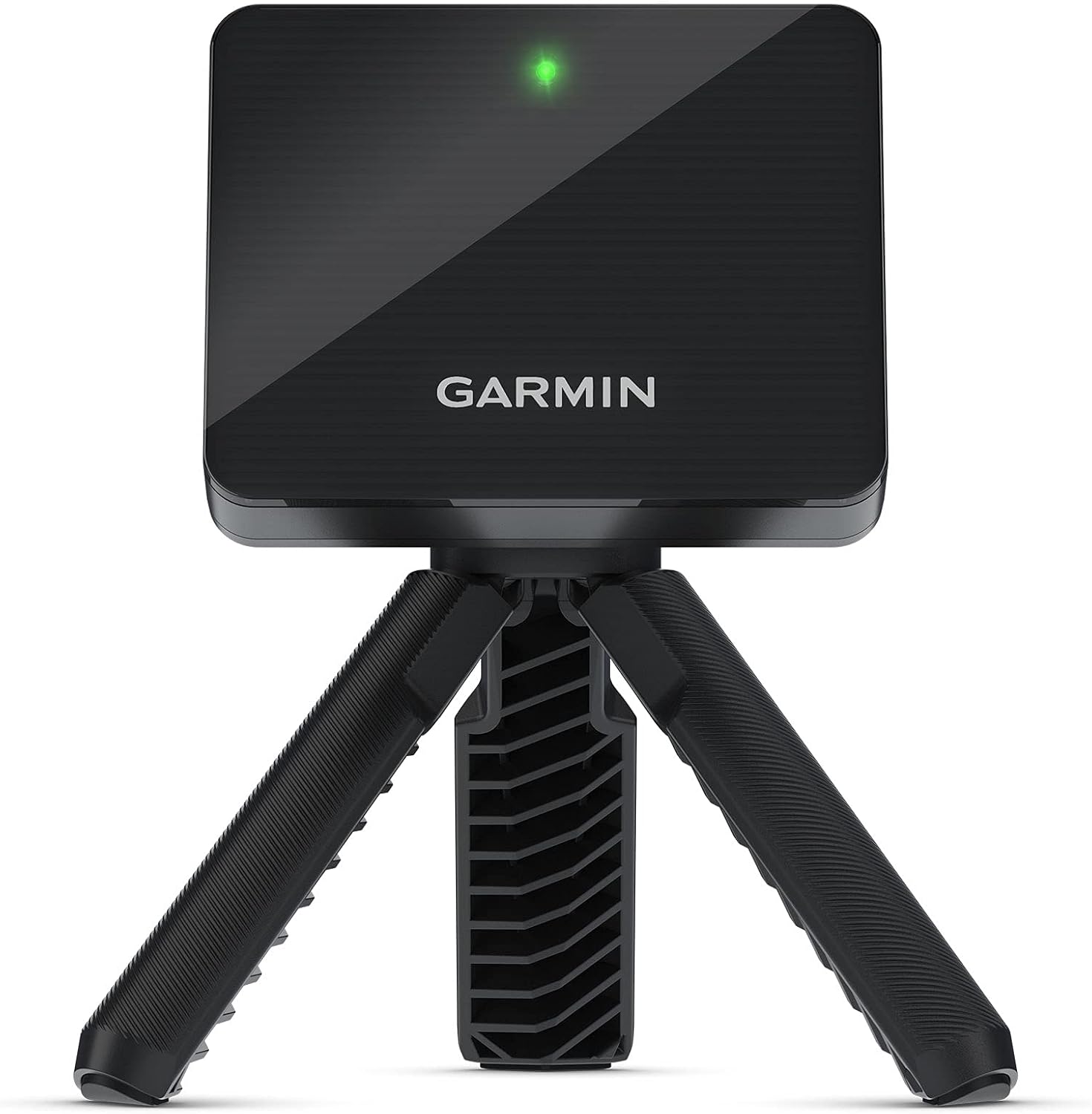
1. Garmin Approach R10 — Best Budget Launch Monitor
Price: ~$499–$599 | Technology: Radar | Subscription: Free core / $99.99/year full
The Garmin R10 has no business being this useful at this price. It’s a pocket-sized radar unit that gives you ball speed, launch angle, spin rate, carry distance, clubhead speed, and smash factor on every shot — data that would have cost $5,000 five years ago. In outdoor conditions with proper setup positioned 8 feet behind the ball, it delivers carry distance readings within 3 to 5 yards of Trackman on most iron shots. That’s entirely acceptable for practice purposes.
The 2026 firmware update added official GSPro compatibility, giving access to 140,000+ virtual course holes for a one-time software purchase. The Garmin Golf app is free for core launch monitor features — no mandatory subscription required to see your data. When you factor in that the Rapsodo MLM2PRO costs $700 and requires a $600 lifetime software unlock for full simulator functionality, the R10 at $499 with free GSPro compatibility is genuinely difficult to argue against as a first launch monitor.
The honest limitations: radar technology calculates spin through algorithms rather than measuring it directly, so spin data is less reliable than camera-based alternatives — particularly on wedge shots indoors where the ball hits a screen before completing its flight path. Short game data suffers more than full iron or driver data. And indoor accuracy drops slightly compared to outdoor use, which affects dedicated simulator setups.
Pros:
- Best-in-class value — $499 for 14+ tracked metrics including the essentials
- No mandatory subscription — free core use, $99.99/year for full course simulation
- GSPro compatible with 140,000+ course holes via one-time software purchase
- Portable — works equally at home, the range, and outdoors on the course
- Accuracy within 3–5 yards of Trackman on full iron shots in outdoor conditions
Cons:
- Radar-calculated spin is less reliable than camera-measured alternatives
- Indoor accuracy drops when the ball hits a screen quickly — affects sim setups under 12 feet
- Short game and wedge data less reliable than full swing metrics
- Requires a paired device (phone or tablet) for real-time data display
Best for: First-time launch monitor buyers who want real shot data and basic simulator capability without spending more than $600 — the easiest entry point in the market.
2. Rapsodo MLM2PRO — Best Mid-Range Launch Monitor
Price: ~$699 (launch monitor) / ~$1,299 with lifetime software unlock | Technology: Dual camera + radar | Subscription: $99.99/year or $599 lifetime
The Rapsodo MLM2PRO is the best launch monitor for most serious weekend golfers in 2026. The combination of dual cameras and Doppler radar produces something the Garmin R10 can’t match: directly measured spin data. Not algorithmically estimated — measured. The difference in wedge and short iron spin accuracy is meaningful for golfers who are working on distance calibration in the 50 to 100 yard range where spin rates determine how far past the flag a ball checks up.
The shot video replay feature is the other standout capability — every shot is captured on video alongside the data, letting you see exactly what the ball did on any specific strike. That combination of visual and data feedback in one device accelerates learning in a way that numbers alone can’t match. For the golfer building a home practice setup around a net and mat, being able to see the shot tracer alongside the carry and spin data closes the feedback loop completely.
GSPro compatibility is included at no extra cost. The device connects over Wi-Fi rather than Bluetooth, producing a more stable data connection in home environments. The honest cost consideration: the $699 launch monitor price requires an additional subscription for full simulator access — $99.99 per year or a one-time $599 lifetime unlock. Over five years, the lifetime unlock makes the total cost around $1,300.
Pros:
- Directly measured spin data — significantly more reliable than radar estimation on all shots
- Shot video replay on every ball provides visual feedback alongside the numbers
- Dual camera + radar hybrid technology covers both indoor and outdoor use cases
- GSPro compatible for full course simulation — no per-session fee
- Wi-Fi connection produces a more stable data feed than Bluetooth alternatives
Cons:
- True total cost is $1,299 for the lifetime software unlock — not the $699 launch monitor alone
- Requires 8+ feet of room depth for reliable indoor readings
- Setup is more complex than the Garmin R10 — Wi-Fi pairing and alignment takes more effort
- Camera technology can struggle in low-light environments indoors without supplemental lighting
Best for: Serious weekend golfers who want directly measured spin data and shot video replay without crossing into the $2,500+ camera-only tier — the best overall performance-to-price in the mid-range.
3. Bushnell Launch Pro — Best Value Professional-Grade Unit
Price: ~$2,499 (unit only) | Technology: Photometric camera (Foresight GC3 hardware) | Subscription: None required for core data
Here’s the most important thing to know about the Bushnell Launch Pro: it is the Foresight GC3 in different clothing. Same three-camera photometric sensor array, same data quality, same indoor accuracy that independent testing consistently places within 1% of Trackman — just at $4,500 less than the Foresight-branded version. This is not a marketing claim; it’s a documented licensing arrangement that makes the Bushnell Launch Pro one of the most compelling value propositions in the entire launch monitor market.
Photometric cameras capture high-speed images at the exact moment of impact. Unlike radar units, accuracy is not affected by whether the ball hits a screen 8 feet away — the camera captures what happened at the ball before flight begins. This makes the Launch Pro significantly more reliable for indoor simulator use than the Garmin R10 or Rapsodo, and equally accurate indoors as outdoors. Spin data, launch angle, face angle, and attack angle are all directly measured rather than algorithmically estimated.
The $2,499 price gets you the unit with core data and FSX Play software including a basic course selection. Advanced club data metrics — dynamic loft, face-to-path, impact location — require the Pro Package subscription at $999/year, which is a real ongoing cost to factor into total ownership. For golfers who primarily want ball data and basic course simulation, the base package is sufficient and the device delivers the best accuracy-per-dollar at this tier.
Pros:
- Identical hardware to the Foresight GC3 at $4,500 less — the most documented value gap in the market
- Photometric accuracy unaffected by indoor ball flight distance — consistent indoors and outdoors
- Directly measured spin, face angle, and attack angle — no algorithmic estimation
- Accuracy within 1% of Trackman on ball speed and carry in independent testing
- No mandatory subscription for core data and basic simulation features
Cons:
- $2,499 for the unit is a significant investment — 5x the Garmin R10 and 2x the Rapsodo
- Advanced club data (dynamic loft, face-to-path) locked behind $999/year Pro Package
- Indoor-only performance advantage — not as portable for outdoor range sessions as radar units
- Photometric cameras require consistent, controlled lighting indoors to perform at their best
Best for: Home simulator builders and serious golfers who want Foresight GC3-level photometric accuracy without the GC3 price tag — the smartest single purchase at the premium entry tier.
4. Foresight Sports GC3 — Best Premium Home Simulator Unit
Price: ~$6,999 (unit) | Technology: Three-camera photometric | Subscription: FSX Pro available
The Foresight GC3 is the point in the launch monitor market where “serious home golfer” becomes “no compromise on data quality.” It uses three precision cameras — one more than the Bushnell Launch Pro — to capture ball and club data at impact with a level of detail and reliability that independent testing places at the top of the consumer-accessible market. The GC3 delivers the same core measurement technology as the GCQuad, Foresight’s tour-grade flagship, with slightly less data depth and one fewer camera.
The built-in touchscreen display means you don’t need a separate device to read data — shot results display on the unit itself, which streamlines the workflow in a dedicated simulator room. The portable, compact design means the GC3 also works at the range and outdoors, giving it a versatility that fixed overhead units can’t match. FSX Pro software integration unlocks full course simulation with hundreds of meticulously modeled courses and the most realistic graphics in the consumer simulator market.
The honest total cost consideration: the launch monitor at $6,999 is just the starting point. A complete GC3 home simulator setup — net, screen, projector, mat, and FSX Pro software — typically runs $10,000 to $15,000 all-in. That’s a real commitment that requires real dedication to home golf practice to justify. For golfers who play frequently and would genuinely use a simulator multiple times per week, the per-session cost becomes more reasonable over a few seasons.
Pros:
- Three-camera photometric accuracy at the top of the consumer market
- Built-in touchscreen — no separate device required for real-time data display
- Portable and outdoor-capable — more versatile than fixed overhead alternatives
- Full FSX Pro course simulation with the most realistic graphics available at this tier
- Independently validated accuracy for both ball and club data that approaches GCQuad performance
Cons:
- $6,999 for the unit alone — a complete simulator build runs $10,000 to $15,000+
- FSX Pro subscription adds ongoing annual cost on top of the hardware investment
- The performance gap vs. the Bushnell Launch Pro (same hardware tier, one fewer camera) requires honest justification
- Overkill for golfers who primarily want ball data for practice — not range/feedback focused
Best for: Dedicated home simulator builders who want the most complete consumer-grade launch monitor available under $10,000 — golfers who play seriously enough to justify the investment through frequent, disciplined use.
5. Trackman — The Gold Standard
Price: ~$13,995 (Trackman iO) / ~$21,495 (Trackman 4) | Technology: Dual radar | Subscription: Trackman Performance Studio
Trackman is the device that every other launch monitor on this list is compared against. It’s the measuring stick for the entire industry. When independent testing evaluates whether the Garmin R10 or the Bushnell Launch Pro is accurate, “accurate” means “close to Trackman.” It’s been the equipment standard on tour ranges, at PGA Tour events, and in the fitting studios of every major manufacturer for over fifteen years.
The Trackman iO, designed specifically for home use, starts at $13,995. The full Trackman 4 — the same system used by tour professionals — starts at $21,495. A complete Trackman 4 home simulator build with enclosure, projector, and installation typically runs $35,000 to $55,000. These are not numbers that require much commentary. They are what they are — the price of the absolute best, with no caveats.
What Trackman delivers for that investment: 44 measured parameters covering every conceivable aspect of ball flight and club delivery, the most accurate spin data available in any consumer device, Trackman Performance Studio software with the most complete fitting and coaching tools available, and the brand recognition that makes a home Trackman a genuine professional-grade installation. When accuracy differences between units are measured in fractions of a percentage point rather than whole yards, you’re in Trackman territory.
The honest answer for most home golfers: the Foresight GC3 or Bushnell Launch Pro delivers 95%+ of Trackman’s real-world practice value for 30 to 70 cents on the dollar. Trackman makes sense for PGA professionals, high-end fitting studios, and the rare serious amateur golfer for whom no compromise is acceptable and the budget is genuinely unlimited.
Pros:
- The industry standard — every other launch monitor exists relative to Trackman
- 44 measured parameters — the most comprehensive data set available in any device
- Trackman Performance Studio is the most complete coaching and fitting software on the market
- Dual radar technology works equally indoors and outdoors in any lighting condition
- No subscription required for core data on the iO home model
Cons:
- Trackman iO starts at $13,995 — a complete build runs $20,000 to $30,000+
- The full Trackman 4 at $21,495 requires a further $4,000+ in annual software subscriptions
- The marginal accuracy advantage over the Foresight GC3 does not justify the price difference for home use
- The cost of entry prices out the vast majority of serious golfers regardless of commitment level
Best for: The rare home golfer for whom money is not a constraint and only the absolute benchmark in launch monitor accuracy and data depth will suffice — or PGA professionals building a home studio.
Buying Guide: What Data Metrics Actually Matter
The Six Numbers That Move the Needle
Trackman measures 44 parameters. Most golfers will improve their game using six. Understanding which metrics to focus on is the difference between data-driven improvement and data-driven confusion.
Ball Speed is the most important single metric for distance. Ball speed is a product of clubhead speed multiplied by smash factor (how efficiently the club transfers energy to the ball). Every mile-per-hour of ball speed gained adds roughly 2 to 2.5 yards of carry. The Garmin R10 measures this reliably.
Carry Distance is what actually matters for club selection and gapping. Not total distance — carry. Knowing you carry your 7-iron 148 yards rather than guessing at 150 eliminates the uncertainty that leads to wrong club selection on approach shots.
Launch Angle tells you whether you’re launching the ball at an optimal angle for your swing speed. Too low means lost carry; too high means lost distance and ballooning. Most amateurs benefit from seeing this number, because intuitive feel for launch angle is unreliable.
Spin Rate is where the quality difference between launch monitors becomes most relevant. Too much spin creates ballooning drives that lose carry. Too little spin in short irons reduces stopping power on approach shots. Directly measured spin (camera-based systems) is more reliable than radar-estimated spin — a meaningful consideration for golfers focused on wedge and short iron calibration.
Smash Factor is ball speed divided by clubhead speed — a measure of how efficiently you’re striking the ball. A smash factor below 1.40 on full driver swings indicates significant off-center contact that’s costing you distance.
Shot Shape and Dispersion — visible on any launch monitor with shot tracer capability — shows you whether your miss pattern is left, right, long, or short on average. Seeing your actual dispersion pattern over 20 shots is more useful than any single perfect shot.
Radar vs. Camera: Which Technology Is Right for You?
Radar units (Garmin R10) sit behind the ball and track flight. Portable, versatile, and budget-friendly — but spin accuracy is estimated rather than measured, and indoor performance drops when the screen is too close to the hitting position.
Camera-based units (Rapsodo MLM2PRO hybrid, Bushnell Launch Pro, Foresight GC3, Trackman) capture impact directly and deliver consistent accuracy indoors regardless of flight distance. Spin data is measured rather than calculated. The trade-off is higher price and less portability for outdoor use.
The practical decision: If your primary use is a dedicated indoor simulator room, camera-based technology (Bushnell Launch Pro minimum) produces meaningfully better data. If your primary use is outdoor range practice and occasional home use, a radar unit like the Garmin R10 delivers entirely adequate accuracy at a fraction of the cost.
Total Cost of Ownership: Add It All Up Before You Buy
The sticker price of a launch monitor is rarely the full cost. Factor in:
- Software subscriptions: Garmin Golf ($99/year), Rapsodo ($99/year or $599 lifetime), Bushnell Launch Pro Pro Package ($999/year for advanced club data)
- Simulator software: GSPro (~$200 one-time), E6 Connect (~$200–$350/year), TGC 2019 (~$80)
- Net, screen, projector, mat: $500 to $2,000+ for a basic home setup
The total first-year cost for a complete Garmin R10 simulator setup runs $1,500 to $2,500. The Rapsodo MLM2PRO with lifetime software and a basic enclosure runs $2,500 to $4,000. The Bushnell Launch Pro complete build runs $5,000 to $8,000. Know the full number before you commit.
Final Verdict
For the golfer starting their data journey, the Garmin Approach R10 at $499 is the right first step — 14+ metrics, GSPro compatible, no mandatory subscription, and accuracy that will genuinely change how you practice. When you’re ready for directly measured spin and shot video replay, the Rapsodo MLM2PRO is the upgrade that matters for most weekend golfers.
For a permanent home simulator build where data quality is non-negotiable, the Bushnell Launch Pro at $2,499 is the smartest purchase in the entire market — photometric accuracy identical to the Foresight GC3 at 65% of the price. If the full Foresight ecosystem and built-in touchscreen are worth the additional investment, the Foresight GC3 at $6,999 is the most complete consumer-grade simulator unit available.
And Trackman is Trackman. If you need to ask whether it’s worth the price, the answer is probably not for your use case — and that’s not a criticism. The Foresight GC3 delivers 95% of Trackman’s practical value for a fraction of its cost. Choose the tool that matches your actual use habits, your available space, and your genuine commitment to practice. The best launch monitor is the one you actually use.
Low Handicap Golf may earn a commission through affiliate links on this page at no additional cost to you. All product recommendations are based on independent research and publicly available testing data. Prices shown are approximate and subject to change.
Leave a Reply